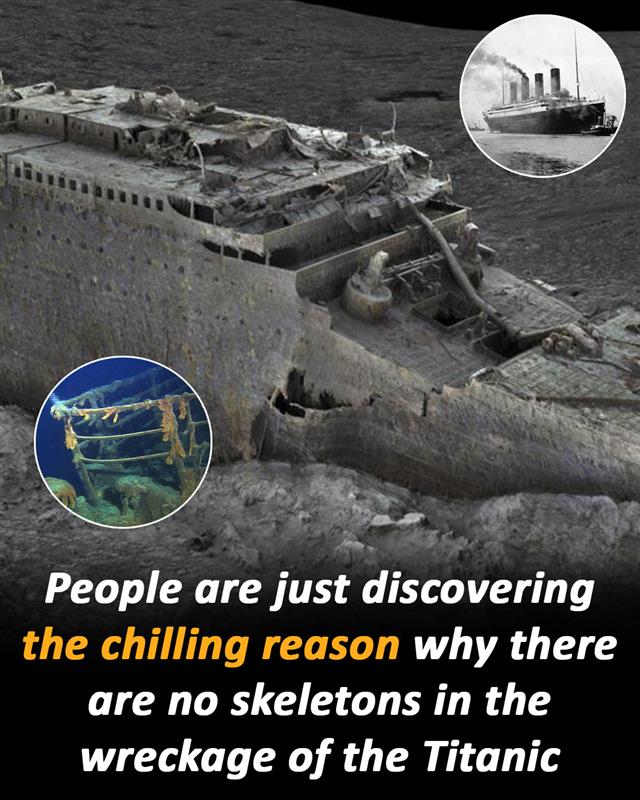
The Mysterious Absence of Bodies in Titanic’s Wreckage
When the RMS Titanic was discovered on September 1, 1985, lying broken and silent on the ocean floor nearly 12,500 feet below the surface, the world collectively held its breath. For over seven decades, the shipwreck had existed only in memories, survivor testimonies, grainy photographs, and the vast mythology surrounding the most famous maritime disaster in history. Now, at last, the resting place of the “unsinkable” ship had been found.
Yet as remotely operated vehicles (ROVs) began to explore the wreckage, another mystery emerged—one that still unsettles historians, marine scientists, and the public alike.
More than 1,500 people died when the Titanic sank in the early hours of April 15, 1912. Many perished trapped inside the ship, others froze to death in the frigid North Atlantic waters, and hundreds were lost at sea. Logically, one might expect at least some human remains to still be present among the twisted steel and decaying interiors of the wreck.
Instead, explorers found shoes. Pairs of shoes. Sometimes neatly arranged, sometimes scattered, but unmistakably human artifacts—without the humans themselves.
The absence of bodies has fueled decades of speculation, conspiracy theories, and eerie fascination. But the real explanation, while less sensational, is no less haunting.
The Scene on the Ocean Floor
The Titanic wreck is not a single intact ship resting peacefully on the seabed. It is a debris field spread across several square miles, consisting of two main sections—the bow and the stern—along with thousands of scattered objects: furniture, dishes, personal belongings, machinery, and fragments of the ship’s structure.
The bow section sits relatively intact, still recognizable as the majestic liner that once carried dreams of luxury and progress. The stern, by contrast, is a mangled mass of steel, torn apart as the ship broke in two during its final plunge.
Despite extensive exploration since 1985, including dozens of manned and unmanned dives, no intact human bodies have ever been found.
This absence is not accidental, nor is it the result of deliberate concealment. It is the consequence of biology, chemistry, physics, and time.
What Happened to the Bodies in the Water?
To understand why bodies are missing from the wreck, we first need to consider what happens to a human body in the open ocean—especially one as cold, deep, and biologically active as the North Atlantic.
The Immediate Aftermath
Some bodies were recovered in the days following the disaster. Rescue ships like the CS Mackay-Bennett retrieved hundreds of victims, embalmed them at sea, and returned them to land for burial. However, many bodies were never found and were left to the ocean.
Those unrecovered bodies are the ones most people imagine still resting with the wreck.
But nature had other plans.
Marine Life: The Ocean’s Efficient Recyclers
One of the most significant factors in the disappearance of bodies is deep-sea scavenging.
Contrary to popular belief, the deep ocean is not a lifeless void. It is home to a variety of organisms uniquely adapted to survive extreme pressure, near-total darkness, and cold temperatures.
Scavengers of the Deep
When organic material—such as a human body—descends into the depths, it becomes a food source. Crustaceans, bacteria, worms, and deep-sea fish quickly begin the process of consumption.
Among the most effective scavengers are:
-
Amphipods, small shrimp-like creatures that swarm remains
-
Bacteria, which break down tissue on a microscopic level
In deep-sea conditions, a body can be reduced to bones in a matter of weeks or months, depending on depth, temperature, and oxygen levels.
Over decades—let alone more than a century—soft tissue does not stand a chance.
Continue reading…
