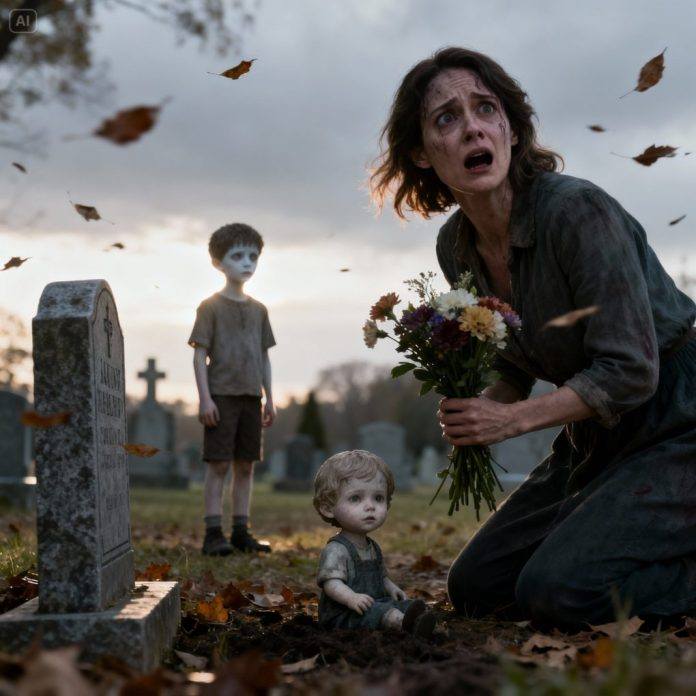
My Son Called Me From His Grave
My son died when he was six.
The day we buried Noah, the sky was cloudless. That detail still feels cruel. Sunshine should be reserved for birthdays and first days of school, not for lowering a small white coffin into the earth.
My husband, Daniel, stood beside me the entire time. His posture was perfect. His face was composed. When the priest finished speaking, Daniel nodded once, as if the man had just delivered a satisfactory report.
He never cried.
Not at the hospital.
Not at the funeral.
Not afterward, when the house echoed with a silence that screamed.
That night, I found myself curled on Noah’s bed, clutching his dinosaur blanket, inhaling the faint scent of his shampoo. Daniel stood in the doorway, watching me the way one might observe a stranger behaving strangely in public.
“You can’t live like this,” he said.
“My son is dead,” I replied into the blanket. “I don’t think living is really on the table right now.”
His jaw tightened. “You’re clinging to a dead child.”
“What did you say?”
“Stop clinging to a dead child,” he repeated, his voice flat, precise. “It’s unhealthy.”
Something in me shattered then. Not loudly. Not dramatically. Just a quiet, irreversible break.
From that moment on, I stopped expecting comfort from my husband.
I began visiting Noah’s grave every day.
Rain or shine. Sick or exhausted. Holidays, weekends, birthdays. The cemetery became my second home, the only place where my grief didn’t feel like an inconvenience.
I talked to him. About everything. The way his favorite treehouse had finally been taken down. How his best friend, Oliver, still asked about him at school. How I couldn’t bring myself to give away his shoes because they still had his footprints molded into the soles.
NOAH ELLIOT CARTER
Beloved Son
Daniel hated it.
“You’re wasting your life,” he snapped one evening when I came home late, dirt still clinging to my knees. “People are starting to talk.”
“Let them,” I said.
“You’re embarrassing me.”
That’s when I realized he wasn’t grieving Noah at all.
He was grieving inconvenience.
It was late autumn when everything changed.
The cemetery was nearly empty, leaves crunching under my boots as I approached Noah’s grave. I knelt, brushing away fallen leaves, and began telling him about a dream I’d had the night before—one where he was laughing, running ahead of me, always just out of reach.
That was when I heard it.
A small voice.
Soft. Hesitant.
“Mom…?”
My breath caught so sharply it hurt.
I turned around.
Standing a few feet behind me was a boy.
He was thin. Pale. His dark hair fell into his eyes in the exact way Noah’s always had, no matter how many times I trimmed it. He wore a blue jacket—the same one Noah had insisted on wearing the day he died.
My heart pounded so hard I thought I might pass out.
“Noah?” I whispered.
He looked up at me, eyes wide and wet.
“Why did you stop coming?” he asked.
I stood so quickly the world spun.
“I—I never stopped,” I said, my voice shaking. “I’m here every day.”
He frowned. “Not before.”
A cold sensation crept up my spine.
“What do you mean, sweetheart?”
He glanced back toward the trees lining the cemetery, then back at me. “I was waiting.”
Every rational part of my brain screamed that this wasn’t real. Grief hallucinations were a thing. I knew that. I had read about them late at night, searching for reassurance that I wasn’t losing my mind.
But hallucinations didn’t crunch leaves beneath their shoes.
Hallucinations didn’t shiver in the cold.
Hallucinations didn’t smell faintly of dirt and rain.
I reached out, my hand trembling, and touched his arm.
It was warm.
I sobbed.
I took him home.
I don’t remember deciding to do it. I just remember gripping his small hand like it was the only solid thing left in the world. He walked beside me quietly, occasionally glancing up as if afraid I might disappear.
The house was dark when we entered.
Daniel wasn’t home yet.
I knelt in front of Noah, cupping his face. “Where have you been?” I whispered.
He shrugged. “I woke up. It was dark. I called for you.”
My throat closed.
“I was there,” I said. “I never left you.”
He looked confused. “You didn’t come down.”
A chill ran through me.
“Down where, honey?”
He hesitated. “Dad said I had to stay quiet.”
My blood ran cold.
“What did your father say?” I asked carefully.
Noah lowered his voice. “He said it was better this way. That you wouldn’t let me go.”
The front door opened.
Daniel froze when he saw us.
For the first time since our son’s death, emotion cracked through his face—not grief, not relief, but something closer to terror.
“You weren’t supposed to bring him back,” he said.
The room seemed to tilt.
“What do you mean?” I asked.
Daniel swallowed hard. “You were destroying yourself. He was holding you here.”
My hands clenched into fists. “You buried our son.”
He shook his head. “No. I hid him.”
The words felt unreal, obscene.
“He was sick,” Daniel continued. “He needed care. Constant care. I couldn’t lose you to that. So I told them he died.”
The room roared in my ears.
“You told me my child was dead,” I said slowly, dangerously.
“You were clinging to him,” Daniel snapped. “You would’ve given up everything.”
I laughed then. A broken, hysterical sound.
“You gave him a grave,” I said. “You let me mourn him. Every day.”
Noah tugged at my sleeve. “Mom… can we go?”
I scooped him into my arms, holding him tighter than I ever had before.
“Yes,” I said, glaring at my husband. “We’re leaving.”
Daniel reached for us.
Noah screamed.
Something in his scream—raw, primal—made Daniel recoil.
We left that night.
The truth came out quickly.
Police reports. Hospital records. A falsified death certificate. Daniel was arrested within days. The world was horrified. Headlines called it monstrous. Incomprehensible.
They asked me how I hadn’t known.
Continue reading…
