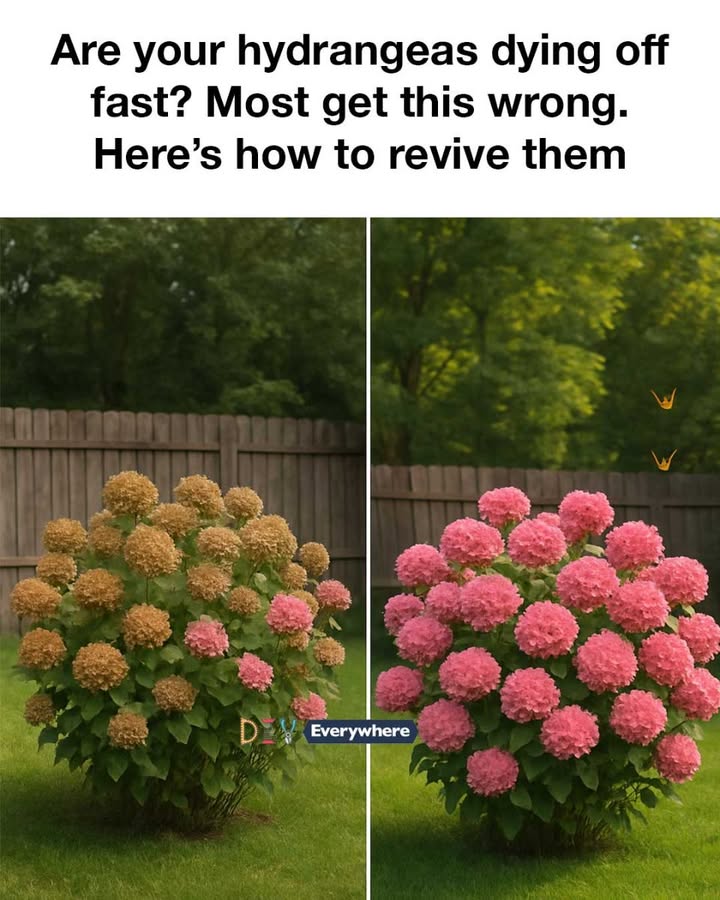
Are Your Hydrangeas Dying Off Fast? Most People Get This Wrong—Here’s How to Revive Them
Hydrangeas have a reputation for being dramatic. One hot afternoon and they’re flopped over like they’ve given up on life. Leaves turn yellow, blooms fade too fast, and suddenly your once-gorgeous shrub looks like it’s on its last breath.
So you water more.
Then you fertilize.
Then you panic.
Hydrangeas rarely die suddenly. What looks like “dying off fast” is usually a stress response, not a death sentence. In fact, many hydrangeas that appear doomed can be fully revived—if you stop treating the symptom and fix the real problem underneath.
Let’s break down why hydrangeas fail, what most gardeners misunderstand, and how to bring your plant back stronger than ever.
Why Hydrangeas Look Like They’re Dying (When They’re Not)
Hydrangeas are masters of visual drama. Wilting, browning, yellowing, and drooping often look catastrophic—but these are usually signals, not final stages.
Here’s the key truth:
Hydrangeas decline slowly. They suffer loudly, but die quietly.
If your plant still has living stems or green at the base, it’s almost always salvageable.
Common “Death” Symptoms That Aren’t Actually Death
-
Midday wilting, especially in summer
-
Crispy or brown leaf edges
-
Yellowing leaves with green veins
-
Stems that look dead above but green below
Each of these has a specific cause—and most of them are fixable.
The Biggest Mistake People Make: Watering the Wrong Way
When hydrangeas struggle, nearly everyone reaches for the hose. And while hydrangeas do love water, how you water matters far more than how much.
Mistake #1: Frequent, Shallow Watering
This is the #1 killer of hydrangeas.
-
Daily sprinkling
-
Quick hose sprays
This trains roots to stay shallow, making the plant more vulnerable to heat and drought.
The Fix: Deep, Infrequent Watering
Hydrangeas need water deep in the soil, not on the surface.
-
Water 2–3 times per week (more in extreme heat)
-
Soak the soil 8–12 inches deep
-
Water slowly for 20–30 minutes at the base
A deeply watered hydrangea may still wilt midday—but it will recover by evening. That’s normal.
Midday Wilting: The Symptom Everyone Misreads
This one causes endless panic.
Your hydrangea looks fine in the morning.
By noon, it’s collapsed.
By evening, it perks back up.
This is called temporary transpiration wilt, and it is not a watering emergency.
Why It Happens
-
Large leaves lose water faster than roots can replace it
-
Hot sun + wind accelerates moisture loss
-
The plant protects itself by drooping
What NOT to Do
-
Don’t water again just because it’s drooping
-
Don’t move the plant immediately
-
Don’t assume it’s dying
If the plant recovers overnight, it’s managing just fine.
When Wilting Is a Problem
-
It stays wilted overnight
-
Leaves feel dry and brittle in the morning
-
Stems begin to shrivel
That’s when you intervene with deep watering and shade protection.
Sun Exposure: Too Much of a Good Thing
Hydrangeas love sunlight—just not the way most people think.
The Sunlight Myth
“Full sun means better blooms.”
Not for hydrangeas.
Most hydrangea varieties prefer:
-
Morning sun
-
Afternoon shade
Full afternoon sun is one of the fastest ways to burn leaves, fade blooms, and stress the plant into decline.
Signs of Too Much Sun
-
Brown or scorched leaf edges
-
Bleached or faded flowers
-
Constant wilting despite moist soil
How to Fix Sun Stress
-
Provide shade cloth during heat waves
-
Plant taller companions to block afternoon sun
-
Move container hydrangeas to partial shade
-
Mulch heavily to cool the root zone
Sometimes revival is as simple as changing the light exposure.
Soil Problems Most Gardeners Ignore
Hydrangeas are picky about soil—but not in the way most people think.
Mistake #2: Focusing Only on pH
Yes, pH affects flower color.
No, pH is not why your plant is dying.
The real issue is usually soil structure.
Hydrangeas Hate:
-
Compacted soil
-
Poor drainage
-
Hard clay that stays wet
-
Sandy soil that dries instantly
Roots need oxygen as much as water. When soil stays soggy, roots suffocate—and the plant declines from the bottom up.
How to Fix Bad Soil
-
Add compost generously (2–4 inches)
-
Mix in aged bark or leaf mold
-
Improve drainage in clay soils
-
Use raised beds if necessary
Healthy roots = instant improvement above ground.
Overfertilizing: The Silent Hydrangea Killer
This one surprises a lot of people.
Hydrangeas that look weak, floppy, or bloom poorly are often overfed, not underfed.
What Overfertilizing Does
-
Encourages leaf growth over flowers
-
Creates soft, weak stems
-
Burns roots
-
Causes yellowing and leaf drop
Signs You’re Using Too Much Fertilizer
-
Lots of leaves, few flowers
-
Rapid growth that collapses easily
-
White crust on soil surface
-
Sudden decline after feeding
The Right Way to Fertilize
-
Use a slow-release fertilizer
-
Feed once in spring, once in early summer
-
Avoid high-nitrogen formulas
-
Stop fertilizing by mid-summer
Sometimes the best fix is to stop fertilizing entirely and flush the soil with water.
Pruning: Where Most Hydrangeas Are Actually Killed
If there’s one mistake that truly can kill your blooms for years, it’s pruning at the wrong time.
The Critical Truth About Hydrangeas
Some hydrangeas bloom on old wood.
Some bloom on new wood.
Prune at the wrong time, and you remove next year’s flowers.
Hydrangeas That Bloom on Old Wood
-
Bigleaf (Hydrangea macrophylla)
-
Mountain hydrangea
-
Oakleaf hydrangea
Prune these immediately after flowering—never in fall or spring.
Continue reading…
