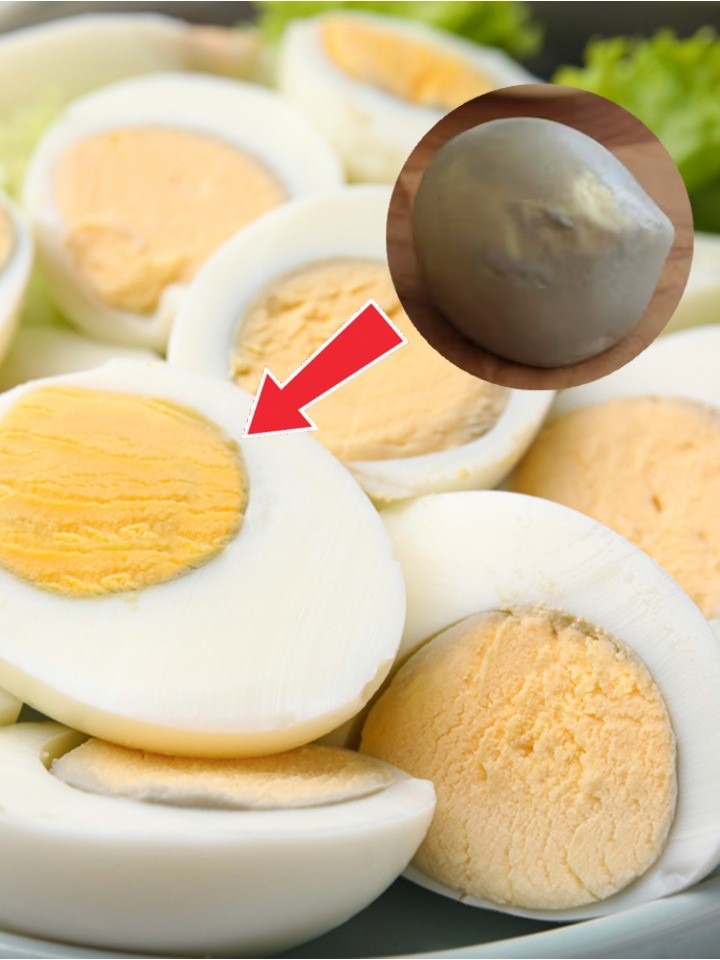
1. What the green ring actually is
The green ring is ferrous sulfide (iron sulfide), a chemical compound that forms when iron from the egg yolk reacts with sulfur from the egg white.
Iron is naturally present in the yolk, which is rich in minerals needed for embryonic development.
When these two elements meet under the right conditions—specifically high heat over time—they react and form iron sulfide, which appears greenish or grayish-green.
Importantly:
The egg is not spoiled
The egg is safe to eat
The color change is purely chemical, not microbial
2. The structure of an egg: setting the stage
To understand why the ring forms at the boundary between white and yolk, it helps to look at the egg’s structure.
~90% water
~10% proteins
Contains sulfur-rich amino acids
Has very little iron
Egg yolk
High in fats and proteins
Contains iron, phosphorus, and other minerals
Physical separation
In a raw egg, the white and yolk are distinct compartments. When heated, however, molecules can move, and chemical reactions begin at their interface.
3. What heat does to egg proteins
When you boil an egg, the most important change is protein denaturation.
Protein denaturation
Proteins are long chains folded into specific shapes
Heat causes them to unfold
Unfolded proteins bond with each other and coagulate, turning liquid egg into a solid
This happens at different temperatures:
Egg whites begin to solidify at ~62–65°C (144–149°F)
Yolks solidify at ~65–70°C (149–158°F)
Hard-boiling requires sustained heat well above these temperatures, often near 100°C (212°F).
4. Sulfur chemistry: where the problem begins
Sulfur in egg whites
Egg whites contain sulfur in the form of sulfur-containing amino acids. Under high heat:
These amino acids break down
Sulfur is released as hydrogen sulfide gas (H₂S)
Hydrogen sulfide:
Has a strong “rotten egg” smell
Is volatile and diffuses easily through the egg
Why overcooking matters
The longer the egg is heated:
The more hydrogen sulfide is produced
The more time it has to migrate toward the yolk
5. Iron chemistry: the yolk’s role
Egg yolks are rich in iron, mostly bound to proteins such as phosvitin.
When hydrogen sulfide reaches the yolk:
It reacts with iron ions (Fe²⁺ or Fe³⁺)
This forms iron sulfide (FeS)
Iron sulfide has a greenish-gray color, and because the reaction happens where sulfur meets iron, the compound forms right at the interface between yolk and white, producing a ring rather than coloring the entire yolk.
6. Why the ring is green (not black or yellow)
Pure iron sulfide is dark gray to black, but in eggs:
It forms as a thin layer
It’s mixed with yolk pigments (like carotenoids)
Light scattering through the egg matrix alters its appearance
The result is a green to green-gray halo, not a solid black line.
7. The role of temperature and time
The green ring is essentially a marker of overcooking.
High temperature
Boiling at a rolling boil exposes the egg to 100°C continuously
This accelerates protein breakdown and sulfur release
Long cooking time
The longer the egg stays hot, the more hydrogen sulfide is produced
Extended heat allows more sulfur to diffuse toward the yolk
Residual heat
Even after removing eggs from boiling water:
The internal temperature continues to rise briefly
This “carryover cooking” can worsen ring formation
8. Why older eggs are more likely to show the ring
Egg age plays a subtle but important role.
Changes in older eggs
Egg white becomes more alkaline over time
Alkalinity promotes sulfur release during heating
The egg white thins, allowing faster diffusion of gases
As a result, older eggs produce more hydrogen sulfide, increasing the chance of iron sulfide formation.
9. pH and alkalinity effects
pH influences both protein stability and sulfur chemistry.
More alkaline whites → more sulfur released
Fresh eggs have slightly acidic whites
As CO₂ escapes through the shell over time, pH rises
This is why:
Fresh eggs are less likely to develop a green ring
Older eggs, when overcooked, show the ring more clearly
10. Why the ring doesn’t form in soft-boiled eggs
Soft-boiled eggs:
Are cooked for less time
Never fully solidify the yolk
Do not generate enough hydrogen sulfide
Do not allow enough time for diffusion and reaction
The critical sulfur-iron reaction simply doesn’t reach completion.
11. Is the green ring harmful?
No. Completely safe.
Safety facts
Iron sulfide is not toxic in the amounts formed
There is no spoilage or bacterial activity involved
The egg is nutritionally almost unchanged
Flavor changes
However:
Overcooked eggs can taste chalky or dry
Sulfur compounds may give a stronger odor
Texture of the yolk may become crumbly
These are quality issues, not safety concerns.
12. Nutritional implications
The formation of the green ring:
Does not significantly reduce protein quality
Does not destroy iron content
Does not make the egg less nutritious
Some heat-sensitive vitamins (like certain B vitamins) may degrade slightly with long cooking, but this is unrelated to the green ring specifically.
13. How to prevent the green ring
Key strategies
Avoid prolonged boiling
Use gentle heat
Cool eggs quickly after cooking
Recommended method
Place eggs in cold water
Bring to a gentle boil
Once boiling, turn off heat and cover
Let sit:
9–10 minutes for large eggs
Transfer immediately to ice water
Why ice water works
Stops cooking instantly
Prevents further sulfur release
Limits diffusion and reaction time
14. Steaming vs boiling
Steaming eggs often results in:
Less green ring formation
More consistent doneness
Easier peeling
This is because:
Steam cooks more gently
Total heat exposure is slightly lower
Cooking time is easier to control
15. Why the ring forms evenly
The ring’s uniform appearance is due to:
Even diffusion of hydrogen sulfide
Spherical geometry of the yolk
Consistent temperature throughout the egg
The yolk acts as a chemical “sink,” reacting wherever sulfur reaches it first—right at its surface.
16. Similar reactions in other foods
This sulfur-metal reaction isn’t unique to eggs.
Examples:
Tarnishing of silverware by sulfur compounds
Blackening of iron cookware by sulfur-rich foods
Greenish discoloration in canned foods with iron salts
Eggs are simply a very visible and familiar example.
17. Historical and culinary perspectives
Historically:
The green ring was once considered a sign of poor cooking
In large-scale food service (schools, hospitals), it was common due to batch cooking
Modern culinary science has largely eliminated it through:
Better temperature control
Rapid cooling techniques
Timed cooking methods
18. Why the myth of “spoiled eggs” persists
The green ring resembles:
Mold discoloration
Continue reading…
