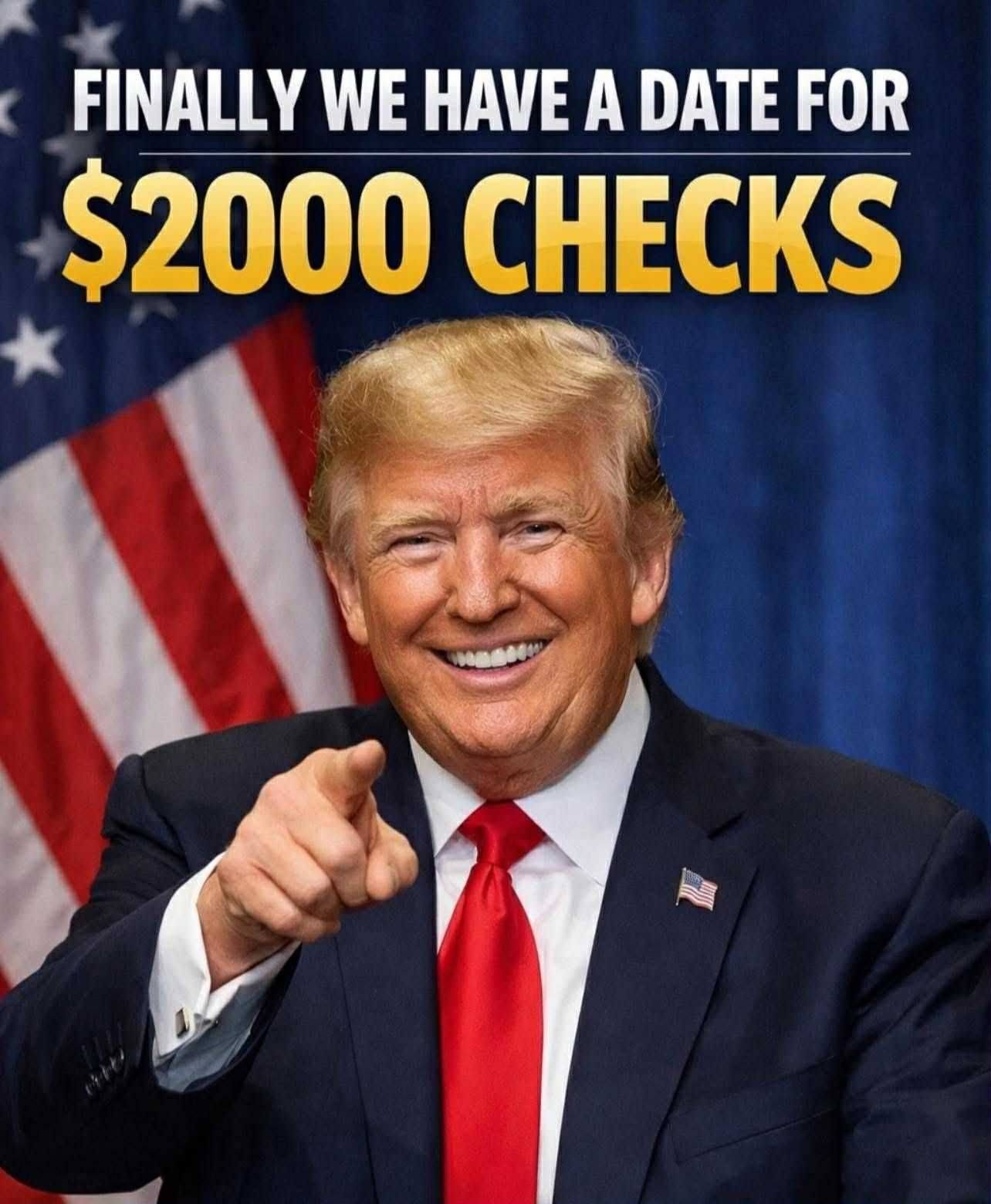
1. What Trump Has Promised
In a series of public statements — most prominently a Truth Social post — President Trump has claimed that the United States will distribute a “tariff dividend” of at least $2,000 per American from revenue generated by his sweeping tariff policies. In that post, he also called opponents of tariffs “fools.”
Amount: At least $2,000 per person for most Americans.
Exclusions: He has said the dividend would not be paid to “high‑income people.”
Rationale Given: Trump has argued tariffs have made the U.S. “the richest, most respected country in the world,” spurring stock market gains, low inflation, and investment.
Debt Reduction Claim: He also suggested that any leftover revenue could be used to pay down the $37–$38 trillion U.S. national debt.
Mixed Messaging: In later statements during a January 2026 interview, Trump appeared uncertain about the timeline and even seemed to momentarily forget the original promise, then suggested payouts “toward the end of the year.”
In summary: Trump’s proposal is to take revenue from tariffs imposed on imports and use it to give direct payments to most Americans, especially low‑ and middle‑income households, while excluding high earners.
2. Background: What Are Tariffs?
A tariff is a tax on imported goods. Traditionally, tariffs serve several purposes:
Protect domestic industries by making imported goods more expensive relative to locally produced ones.
Influence trade balances.
Tariff revenue is collected at ports of entry and then goes into the federal treasury, where it becomes part of overall fiscal receipts — not a separate fund automatically earmarked for rebates.
Under Trump’s presidency, import duties on a very wide range of goods — from steel and electronics to consumer products — were dramatically increased. These tariffs have led to higher prices for U.S. consumers and businesses, since importers often pass the cost on to buyers.
3. Legal and Practical Hurdles
A. Supreme Court Scrutiny
Trump’s tariffs are currently under legal challenge in the U.S. Supreme Court, raising questions about his authority to impose tariffs without specific congressional approval under the Constitution.
The Court has heard cases on whether Trump’s use of emergency powers to justify sweeping tariffs overstepped executive authority.
The outcome of the case could affect not only the tariffs themselves but also the idea of tariff revenue being used for direct payments.
B. Congress and Implementation
Even if the tariffs remain in place, Trump cannot issue $2,000 checks on his own. For federal funds to be distributed in this way, Congress would almost certainly have to pass legislation authorizing the tariff dividend.
Republican Senator Josh Hawley had earlier proposed a bill to give a $600 tariff rebate to most Americans — a smaller, more conventional rebate idea.
Without legislative action, a large‑scale payout program has no legal mechanism to operate.
4. How Much Money Is Actually Available?
Here’s where policy claims collide with fiscal math:
Actual Tariff Revenues
As of the 2025 fiscal year, tariffs brought in roughly $195–$220 billion in revenue — a significant figure but small compared with the cost of Trump’s proposed program.
Projected revenue for fiscal 2026 is around $217 billion.
Cost of the Dividend
If every adult American (about 163 million taxpayers) received $2,000, the total would be around $326 billion, even before excluding high‑income people. Add children and it could exceed $600 billion.
Expert Consensus
Budget and economic experts note that tariff revenue would not be enough to fund the proposal at the scale Trump suggests. Many say the revenue would not even come close to the amount needed.
The Tax Foundation and other analysts have described Trump’s estimates of “trillions” in tariff revenue as greatly exaggerated and not reflective of actual net gains.
Conclusion: Even at peak collection, tariff revenue represents a fraction of the cost of universal $2,000 payments.
5. Economic Impacts and Critiques
Economists and commentators have been sharply divided on the proposal.
A. Critics’ Views
Economic Distortions
Economist Peter Schiff argued the plan could “defeat the very purpose of tariffs.” His reasoning: if citizens receive cash, they might buy more imports — increasing the trade deficit the tariffs were supposed to reduce.
Hidden Tax on Consumers
Tariffs function as a tax on U.S. consumers, because importers often pass the cost of extra duties onto buyers through higher prices. Many economists argue that rebate checks would only partially offset increased costs imposed by tariffs.
B. Supporters’ Arguments
Supporters of tariff rebates frame them as:
A way to redistribute tariff revenue back to American workers.
Compensation for higher prices caused by foreign goods tariffs.
Boosters for domestic manufacturing jobs.
Some proponents also argue that such direct payments could stimulate consumer spending, potentially bolstering economic growth.
6. Political Motivations and Messaging
Trump’s tariff dividend promise comes at a politically sensitive time:
A. Rallying Support
Calling opponents of tariffs “fools” is part of a broader strategy to rally the base around economic nationalism and protectionism.
The $2,000 payout idea also serves to frame tariffs as not just punitive to foreign competitors, but beneficial to American consumers.
B. Messaging vs. Reality
Continue reading…
