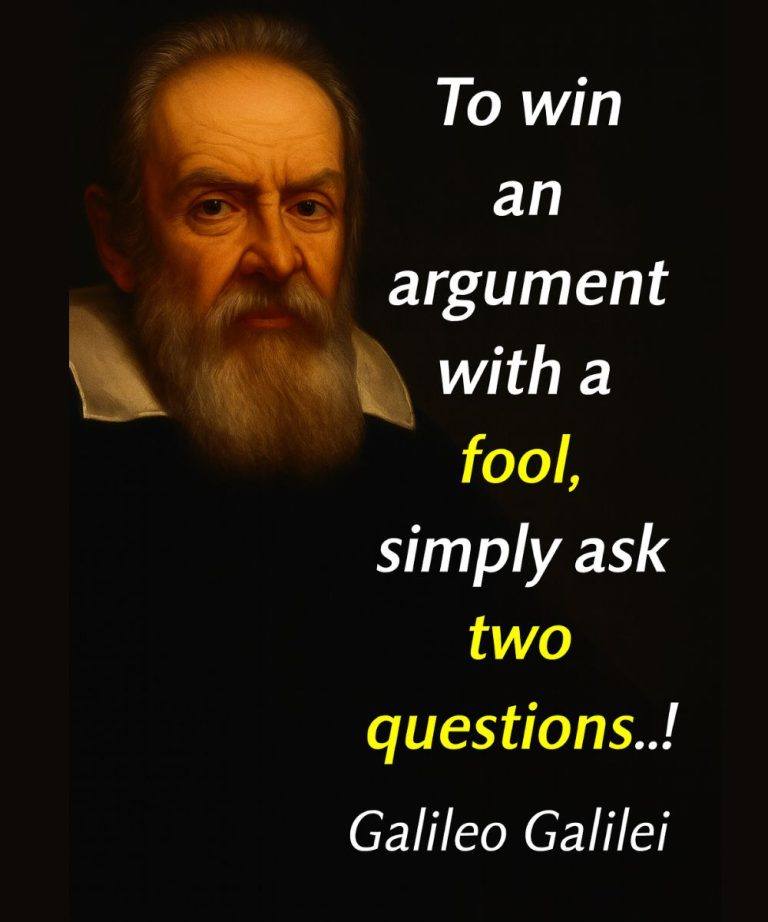
A fool does not argue to discover what is correct.
They argue to:
Protect ego
Vent frustration
Feel superior
Avoid shame
No amount of logic can compete with emotional self-preservation.
This is why you leave arguments with fools feeling:
Exhausted
Angry
Unheard
You weren’t debating facts.
You were wrestling someone’s identity.
The Biggest Trap: Thinking You’re Immune
One of the most dangerous thoughts in any argument is:
At least I’m being rational.
The moment you think this, you stop listening and start performing.
The fool thrives here.
Why?
At that point, the fool has already won—not because they’re right, but because they’ve successfully pulled you into their arena.
And their arena is chaos.
So What Is the Smartest Way to Win?
Here it is, plain and simple:
You win by refusing to play the fool’s game while still protecting your dignity, time, and clarity.
That doesn’t mean silence.
It doesn’t mean weakness.
And it definitely doesn’t mean letting nonsense go unchallenged every time.
It means choosing which kind of victory actually matters.
Let’s break this down.
Level 1: Recognize the Type of Fool You’re Dealing With
Not all fools are the same, and strategy matters.
1. The Loud Fool
Talks over others
Repeats the same point
Thinks volume equals truth
Best move: Let them talk themselves into exhaustion.
Silence makes them uncomfortable. Calm makes them look unstable.
2. The Confidently Wrong Fool
States falsehoods as obvious facts
Refuses sources unless they already agree
Smirks a lot
Best move: Ask simple, neutral questions they can’t answer without exposing gaps.
3. The Goalpost Shifter
Changes the topic when challenged
Says “That’s not what I meant” constantly
Never settles on a clear claim
Best move: Pin one claim at a time and refuse to move until it’s resolved—or walk away.
4. The Victim Fool
Claims they’re being attacked
Accuses you of tone problems
Uses emotion as a shield
Best move: Lower intensity, restate positions calmly, and disengage early.
Knowing the type prevents you from wasting energy on the wrong tactics.
Level 2: Control the Frame, Not the Facts
This is where most smart people fail.
They focus on facts, while the fool controls the frame.
The frame is:
What the argument is “about”
Who looks reasonable
What counts as evidence
Who seems emotional
If you’re frantically citing studies while the fool is mocking you, you’re losing the frame.
The smartest move is to slow everything down.
Phrases that help:
“Let’s clarify one thing at a time.”
“What exactly would change your mind?”
“That’s a different issue—can we finish this one first?”
If the fool refuses to engage within a clear frame, you’ve learned something valuable: they’re not there to reason.
At that point, continuing is optional—not obligatory.
Level 3: Ask Questions That Reveal, Not Attack
Arguing directly with a fool often backfires.
But questions do something magical.
They force the other person to:
Commit to a position
Expose contradictions
Hear their own reasoning out loud
Good questions are:
Calm
Specific
Non-sarcastic
Examples:
“How did you come to that conclusion?”
“What evidence would count against that view?”
“Can you walk me through the steps of that logic?”
A fool will either:
Dodge the question
Get defensive
Contradict themselves
None of those outcomes require you to “win” aggressively. The exposure happens naturally.
Level 4: Know When the Audience Matters More Than the Fool
Here’s a crucial insight:
In many arguments, the fool is not your real audience.
If the argument is public—online, at work, in a group—the smartest move is often to aim your clarity at the bystanders, not the fool.
Why?
Because fools rarely change their minds in public. Doing so feels like humiliation.
But others are watching:
How calm you are
How coherent your points are
Whether you stay grounded or spiral
In these situations, winning looks like:
Short, clear responses
No insults
No over-explaining
No emotional hooks
Eventually, the fool either escalates (and discredits themselves) or disengages.
You don’t need to defeat them.
You just need to remain credible.
Level 5: Disengagement Is Not Defeat
This is the hardest lesson for intelligent, articulate people.
Walking away feels like losing.
It’s not.
It’s selective engagement.
Time and attention are finite resources.
Spending them on someone committed to misunderstanding you is not noble—it’s wasteful.
A clean disengagement sounds like:
“We’re not going to agree on this.”
“I don’t think this conversation is productive.”
“Let’s drop it.”
No dramatic exit.
No final jab.
No need to convince.
The fool may claim victory.
Let them.
Real victory is leaving with your peace intact.
The Ultimate Power Move: Not Needing to Be Right
Here’s the quiet truth no one tells you:
The more secure you are in your understanding, the less you need to prove it.
Fools argue because they need validation.
They need to be seen as right, strong, dominant, or superior.
When you stop needing that, their power evaporates.
You can say:
“I might be wrong.”
“That’s worth thinking about.”
“I don’t know enough to say.”
A fool cannot operate in that space.
It offers no leverage.
But What If the Fool Is Someone You Can’t Avoid?
Family. Coworkers. Bosses. Partners.
This changes the strategy.
Winning here means:
Minimizing conflict
Preserving relationships
Choosing long-term stability over short-term correctness
Sometimes the smartest response is:
A nod
A neutral “Maybe”
Changing the subject
Not every false statement requires correction.
Not every provocation deserves a response.
Wisdom is knowing the difference.
The Paradox: The Smarter You Get, the Less You Argue
As people grow wiser, something interesting happens.
They:
Argue less
Listen more
Choose silence strategically
Ask better questions
Let go of the need to dominate
Not because they can’t argue—but because they understand the cost.
Arguing with a fool doesn’t just waste time.
It trains you to think in shallow, reactive ways.
And that’s the real danger.
Final Definition of Winning
So let’s redefine it properly.
You win an argument with a fool when:
You don’t compromise your values
You don’t lose your composure
You don’t sacrifice clarity for ego
You don’t give away more energy than the situation deserves
Sometimes that means speaking.
Sometimes that means questioning.
Sometimes that means silence.
The fool will keep arguing.
You’ll be busy living.
And that, quietly and consistently, is the smartest win there is.
