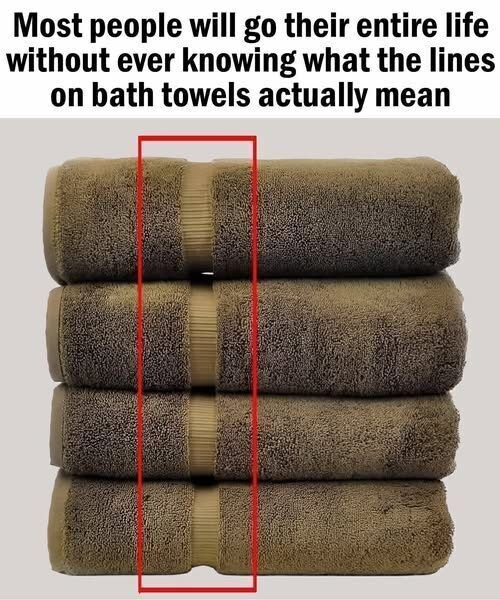
Those lines exist for functionality first, aesthetics second.
Here’s what they actually do.
Ever notice how the edges of cheap towels curl up after washing?
That’s because terry cloth—the fluffy looped fabric that makes towels absorbent—is very flexible. When it absorbs water and heat, it expands unevenly. Over time, that causes twisting, curling, and warping.
The dobby border acts like a structural anchor.
It:
Stabilizes the towel’s shape
Keeps the edges straight
Prevents excessive stretching
Helps the towel lie flat over time
2. They Control Shrinkage (Yes, Really)
Towels go through a lot:
Hot water
High heat
Aggressive spinning
Being yanked off hooks by sleepy humans
The tightly woven border shrinks at a different rate than the terry cloth. This controlled contrast helps balance the towel’s overall shrinkage so it doesn’t distort after repeated washes.
Those lines help your towel survive the laundry gauntlet.
3. They Increase Durability Where Towels Fail Most
Think about where towels wear out first.
Not the middle.
The edges.
That’s where:
You pull them
You hang them
You fold them
They rub against towel bars and hooks
The dobby border reinforces the towel at its weakest points, making it last significantly longer.
This is especially important in:
Hotels
Spas
Gyms
Hospitals
Places where towels are washed daily and abused relentlessly.
But Wait—There’s More
If the dobby border were only about durability, manufacturers could’ve stopped there.
But towels are a perfect example of design meeting human behavior.
Because towels aren’t just used.
They’re handled.
4. They Help With Folding and Alignment
Subconsciously, humans love visual cues.
Those lines give your brain a reference point for:
Folding evenly
Hanging symmetrically
Lining up towels on a rack
That’s why towels with borders always look “neater” than those without.
Hotels figured this out long ago.
A folded towel with clean dobby borders:
Looks intentional
Signals cleanliness
Feels luxurious
Same towel.
Different psychological impact.
5. They Improve Grip When Drying
Here’s a fun one people rarely notice.
The contrast between fluffy terry cloth and smooth dobby weave gives your hands better grip when drying off.
Especially when:
Your hands are wet
The towel is damp
You’re twisting or rubbing vigorously
It’s subtle—but it matters.
A Brief (But Fascinating) History of the Towel
To really appreciate those lines, we need to step back in time.
Ancient Towels Weren’t What You Think
The earliest “towels” were more like:
Linen cloths
Strips of fabric
Animal skins (yes, really)
In Ancient Rome, people used linteum, a linen cloth for drying hands and bodies in bathhouses.
No fluffy loops.
No borders.
No softness.
Just function.
The Ottoman Empire Changed Everything
The modern towel as we know it originated in Turkey in the 17th century.
In the city of Bursa, textile artisans developed looped pile fabric—what we now call terry cloth—specifically for use in Turkish baths (hammams).
These towels, called peshtemals, were:
Highly absorbent
Durable
Designed for repeated washing
And yes—many of them featured woven borders to prevent fraying.
Sound familiar?
Industrialization Made Borders Essential
When towel production scaled up during the Industrial Revolution, borders became non-negotiable.
Mass-produced towels needed:
Shape retention
Consistency
Longevity
The dobby border solved all three.
And once something works and looks good, it tends to stick around.
Why Do Even Cheap Towels Have Them?
Here’s where it gets interesting.
Even low-cost towels often include some form of border.
Why?
Because without it:
Returns increase
Customer complaints rise
Product lifespan drops
Brand reputation suffers
In short:
A towel without borders costs more in the long run.
So manufacturers keep them—even if they simplify the design.
Luxury Towels Use Borders as a Status Symbol
Now flip the script.
High-end towels don’t just have borders.
They show them off.
Luxury brands use dobby borders to:
Display intricate patterns
Signal craftsmanship
Separate themselves visually from basic towels
Some even use:
Gold-thread accents
Monogram frames
Multi-texture borders
Same functional principle.
Elevated execution.
The Psychology of Familiar Objects
Here’s the part nobody expects.
Those lines don’t just serve your towel.
They serve you.
Humans find comfort in familiarity. Repeated patterns in everyday objects create a sense of normalcy and order.
That’s why:
A towel without borders feels “off”
A smooth-edged towel feels unfinished
A missing border is noticeable—even if you can’t explain why
Your brain has been trained since childhood to expect them.
They’re part of the idea of a towel.
Are There Towels Without Those Lines?
Yes—but they’re rare, and usually intentional.
You’ll find them in:
Minimalist designs
Microfiber sports towels
Ultra-modern spa aesthetics
And notice something interesting?
They’re often marketed as:
“Innovative”
“Modern”
“Disruptive”
Because removing the border goes against centuries of textile tradition.
The Internet Had The Same Question You Did
This mystery pops up online constantly.
Search forums, social media, and comment sections, and you’ll find:
Jokes about towel hieroglyphics
Wild theories
Confident wrong answers
Because it’s one of those things everyone notices—but no one is taught.
And once you know?
You can’t unsee it.
Next Time You Use a Towel…
You’ll notice:
How the border feels different
How it holds the towel together
How it frames the fabric
That ordinary object just got a little more extraordinary.
The Quiet Genius of Everyday Design
The lines on towels are a perfect reminder that:
The most well-designed things rarely demand attention.
They just work.
Silently.
Reliably.
For decades.
Those mysterious lines aren’t there to confuse you.
They’re there because someone, somewhere, once thought very carefully about how humans dry themselves—and decided that even the simplest object deserved thoughtful design.
Story Of The Day Takeaway
So the next time someone asks:
“What are those lines on towels for?”
You can smile and say:
“They keep your towel straight, strong, absorbent, durable, and quietly perfect.”
And then watch as they stare at their towel like it’s just revealed a long-kept secret.
Because honestly?
It has.
