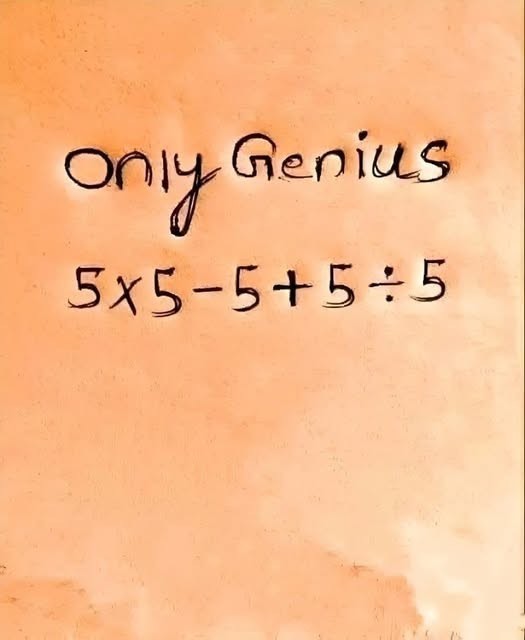
Common Types of Viral Math Puzzles
Viral math puzzles come in many forms, but most fall into one of several categories:
Logic-based puzzles
Here, the solution is not arithmetic but reasoning. Examples include questions like, “If some statements are true and others false, which one must be true?”
Word-number hybrids
These puzzles disguise numerical solutions in words, such as using the number of letters in a word to generate a sequence.
Trick questions
Sometimes the solution is not mathematical at all—it relies on reading the problem carefully. Many viral puzzles are designed to mislead you with superfluous information.
A Step-by-Step Strategy for Solving in 10 Seconds
Now, let’s get practical. How do you actually solve these puzzles fast? Here’s a strategy that combines logic, speed, and mental flexibility:
Read the puzzle carefully
Don’t rush. Most “trick” puzzles fail because you overlook a crucial detail.
Identify patterns
Look for repeated structures, sequences, or relationships. Often the answer is hidden in the pattern, not in complex calculations.
Simplify the problem
Break it down. If a sequence is too complicated, try examining smaller parts or previous numbers.
Check for trick elements
If your solution seems too hard, the puzzle might rely on a clever twist rather than arithmetic.
Practice
Like all skills, speed comes with repetition. The more puzzles you try, the better you get at spotting hidden clues quickly.
Example Puzzle Walkthrough
Let’s solve one together. Here’s a classic:
Puzzle:
A bat and a ball cost $1.10 in total. The bat costs $1 more than the ball. How much does the ball cost?
Many people immediately say “10 cents,” but let’s calculate carefully:
Let the ball’s cost = x
Total cost = x + (x + 1) = 2x + 1 = 1.10
Solve for x: 2x = 0.10 → x = 0.05
✅ Correct answer: The ball costs 5 cents.
Notice how easy it is to be tricked by intuition. This is exactly why these puzzles are so effective—they test both logic and your ability to pause and think clearly under pressure.
The Psychology Behind Viral Math Challenges
Why do puzzles like these go viral? Social scientists suggest several factors:
Challenge and reward: People enjoy being tested and proving their intellect.
Shareability: A puzzle that seems simple but can stump friends encourages social engagement.
Self-assessment: We love measuring ourselves against a “genius” standard.
Gamification of learning: Quick puzzles tap into the same pleasure centers as games, making learning feel fun.
In essence, these puzzles are not just math exercises—they are mini games for the mind.
How to Train Your Brain for 10-Second Problem Solving
If you want to consistently solve these puzzles in seconds, you can train your brain like an athlete trains their body. Here are some tips:
Daily practice: Dedicate even 10 minutes a day to solving tricky puzzles. Apps and puzzle books are excellent tools.
Work on mental math: Speedy calculation improves confidence and reduces errors under pressure.
Play logic games: Chess, Sudoku, and strategy games enhance pattern recognition.
Analyze mistakes: Every puzzle you get wrong is a chance to learn a new pattern or trick.
Famous Math Puzzles That Stump Even Geniuses
Throughout history, some puzzles have gained notoriety for being deceptively tricky:
The Monty Hall Problem: A probability puzzle that defies intuition. Most people choose the wrong door.
The Missing Dollar Riddle: A classic accounting trick that confuses even brilliant minds.
Magic Squares and Cubes: Arranging numbers to satisfy multiple conditions simultaneously.
These puzzles illustrate that genius is not just about knowing mathematics—it’s about thinking differently and recognizing hidden patterns.
Why Speed Matters (and Sometimes Doesn’t)
In the world of viral math puzzles, solving a problem in 10 seconds is a badge of honor. But in real-world mathematics, speed is secondary to understanding. What these puzzles teach us is flexibility and pattern recognition, skills far more valuable than racing against the clock.
Think of it this way: a ten-second puzzle is like a brain teaser workout. It strengthens your mental agility, attention to detail, and problem-solving stamina.
The Social Side of Math Puzzles
One reason these puzzles explode online is because they are inherently social. Sharing a puzzle is a way of saying:
“Test your brain!”
“Are you smarter than your friends?”
“I solved it—can you?”
This social pressure creates a feedback loop: the more people try and fail, the more others want to attempt it themselves. It’s a psychological phenomenon called competitive motivation, and it’s why these challenges spread like wildfire.
Conclusion: Are You a Genius?
So, are you a genius if you solve a puzzle in 10 seconds? Maybe. But more importantly, even attempting these puzzles exercises your brain, teaches logical thinking, and trains you to spot patterns quickly. Genius isn’t just a label—it’s a skill cultivated through curiosity, persistence, and strategic thinking.
The next time you encounter a puzzle claiming to test your intelligence in seconds, remember this:
Slow down and read carefully
Look for hidden patterns
Test hypotheses quickly
Don’t be afraid to make mistakes
Whether or not you solve it in 10 seconds, you are engaging your mind in ways that few daily activities can. And who knows? Maybe the real genius is enjoying the process itself.
