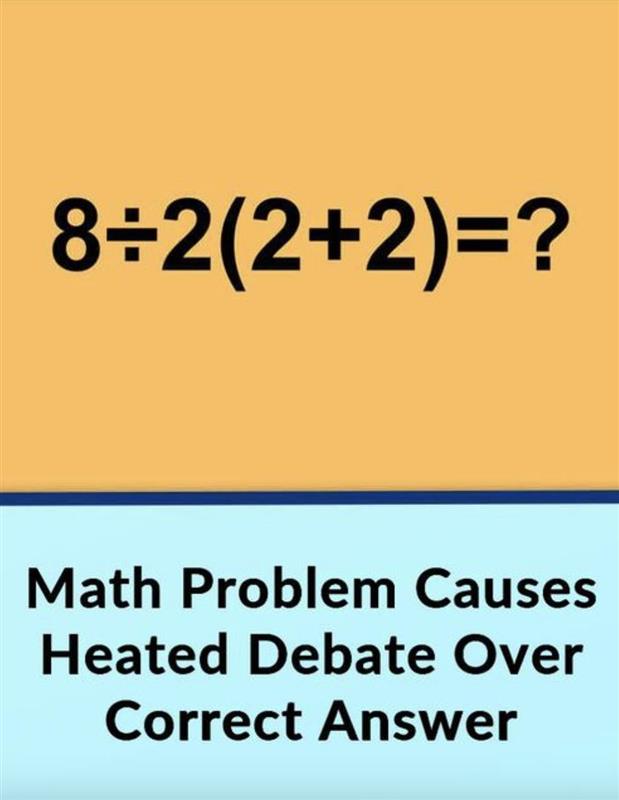
So which group is right?
PEMDAS Enters the Chat
Most people were taught this in school as the order of operations:
Parentheses
Exponents
Multiplication
Division
Addition
Subtraction
Often remembered with the mnemonic “Please Excuse My Dear Aunt Sally.”
Many people incorrectly believe that multiplication always comes before division. But that’s not what PEMDAS actually says.
Multiplication and division are on the same level of priority. The same goes for addition and subtraction. When operations share the same level, you evaluate them from left to right.
This detail is crucial—and often glossed over in classrooms.
The Correct Mathematical Interpretation
Let’s rewrite the expression carefully:
8 ÷ 2(2 + 2)
Step 1: Parentheses
(2 + 2) = 4
8 ÷ 2 × 4
There are no parentheses left. There are no exponents. What remains are division and multiplication, which have equal priority.
According to standard mathematical convention, we now evaluate from left to right:
8 ÷ 2 = 4
4 × 4 = 16
The correct answer is 16.
This is not a matter of opinion. It’s not regional. It’s not “new math.” It follows standard, internationally accepted rules of arithmetic.
So why did so many people get 1?
The Trap of Implied Multiplication
The real culprit behind the confusion is something called implied multiplication.
Implied multiplication happens when a multiplication sign is omitted, such as:
2(4)
3x
ab
In higher-level mathematics, implied multiplication is extremely common. In algebra, for example, we almost never write a multiplication symbol between a number and a variable.
Some people were taught—explicitly or implicitly—that implied multiplication has higher priority than division. This belief likely comes from how expressions are written, not from formal rules.
For example:
1 ÷ 2x is often intended to mean 1 ÷ (2x)
In textbooks, authors usually avoid ambiguous expressions altogether
But intention is not the same as convention.
In standard arithmetic, 2(4) is simply 2 × 4, no more special than writing 2 × 4 explicitly. It does not automatically create a grouping unless parentheses are added.
Why Calculators “Disagreed”
One of the most fascinating parts of the 2019 debate was the calculator controversy.
Some people typed the equation into their calculators and got 1. Others got 16. Chaos ensued.
The reason? Different calculators handle implied multiplication differently.
Basic calculators often process expressions strictly left to right.
Some scientific calculators give implied multiplication higher priority.
Online calculators vary depending on how they parse the input.
This inconsistency reinforced the belief that the problem was ambiguous—or that math itself was unreliable.
But calculators don’t define math. They implement rules chosen by programmers. When calculators disagree, it’s not math failing—it’s user interface design colliding with human assumptions.
The Real Problem Isn’t the Equation
Here’s the uncomfortable truth:
The equation didn’t divide the internet because it was tricky.
It divided the internet because most people were never taught the order of operations deeply enough to defend it.
Many of us learned PEMDAS as a chant, not as a system. We memorized the acronym but never fully understood:
Why multiplication and division share priority
Why left-to-right evaluation matters
Why mathematicians avoid ambiguous notation
As a result, when confronted with a slightly unusual-looking expression, people relied on intuition instead of rules.
And intuition is unreliable in math.
Math as a Social Identity
Another reason this problem went viral is psychological.
Math isn’t just a subject—it’s an identity marker.
Getting the “right” answer feels like proof of intelligence
Being told you’re wrong feels like a personal attack
Public comment sections turn disagreement into performance
Once people picked a side, they defended it fiercely. Admitting error in front of thousands of strangers is hard. So instead, many doubled down, cherry-picked explanations, or accused others of ignorance.
The equation became less about math and more about ego.
How Mathematicians Would Actually Write It
Ironically, professional mathematicians almost never write expressions like 8 ÷ 2(2 + 2).
It’s considered bad notation.
To avoid confusion, a mathematician would write one of the following:
(8 ÷ 2)(2 + 2)
8 ÷ [2(2 + 2)]
8 / (2 × (2 + 2))
Clear notation prevents pointless arguments.
The viral problem succeeded because it was poorly written.
Lessons from the Internet’s Favorite Math Fight
So what did we learn from the 2019 math problem that broke social media?
1. Math rules are precise—even when people aren’t
There is a correct answer, regardless of popular opinion.
2. Education often prioritizes shortcuts over understanding
Mnemonics like PEMDAS help, but they aren’t enough on their own.
3. Ambiguity is the enemy of clarity
If an expression can be misread, it probably will be.
4. The internet amplifies confidence, not correctness
The loudest voices are not always the most accurate ones.
Final Answer (Once and for All)
Let’s settle it clearly:
8 ÷ 2(2 + 2) = 16
If you got 1, you’re not stupid. You were likely taught a mental shortcut that doesn’t hold up under formal rules. The real failure isn’t yours—it’s how math is often taught and communicated.
And if nothing else, the great math war of 2019 gave us something rare: a reminder that even the simplest questions can reveal how much we still have to learn.
