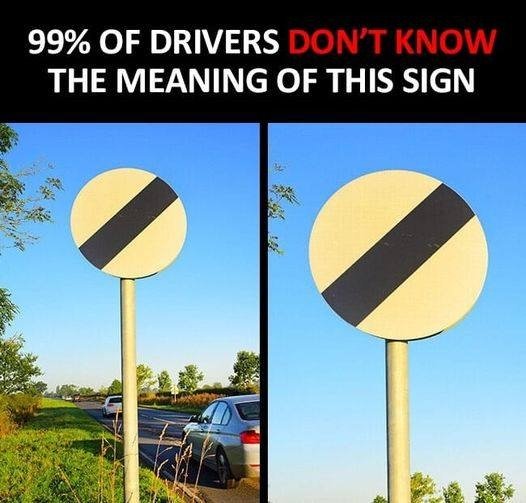
The National Speed Limit
Introduction
Traffic signs are ubiquitous on roads worldwide, serving as silent yet powerful regulators of behavior. Among these, the “National Speed Limit” sign is perhaps one of the most misunderstood and debated. Unlike standard speed limit signs, which explicitly state the maximum speed in numbers, the National Speed Limit (NSL) sign often appears as a blank white circle with a black diagonal stripe across it, leaving many drivers puzzled about its meaning and enforcement. This essay seeks to demystify this enigmatic traffic sign by exploring its history, rationale, impact on road safety, psychological effects on drivers, and contemporary debates surrounding its efficacy.
The concept of regulating vehicle speed is as old as motorized transport itself. Early speed limits, such as the 1865 “Red Flag Act” in the UK, required a pedestrian to walk in front of vehicles carrying a flag to warn pedestrians—a reflection of societal fear of motorized transport. By the early 20th century, with the rise of automobiles, formal speed limits began to emerge, initially as a means to protect pedestrians and horses.
The modern NSL sign, however, was introduced in the UK in 1965. It was designed to simplify speed regulation on rural roads where traditional numeric signs would be cumbersome. The NSL indicated that vehicles should travel at the “national speed limit” for the type of road and vehicle, rather than a fixed number displayed on every road. For instance, in the UK, the NSL implies a maximum of 60 mph on single carriageways and 70 mph on dual carriageways and motorways for cars.
Other countries have similar concepts, although the visual representation and legal implications differ. In Germany, for instance, the absence of a speed limit sign on the Autobahn often implies an unrestricted maximum speed, while the presence of a numeric sign indicates a specific limit. Understanding these historical and regional nuances is crucial for comprehending why the NSL exists and why it remains “mysterious” to many drivers.
2. Design and Symbolism
The design of the NSL sign—a white circle with a single black diagonal stripe—might seem minimalist to the point of vagueness. This design choice is intentional, rooted in semiotics: the diagonal stripe universally signals “end of restriction” in European road signage conventions. Unlike signs with numbers, which directly communicate limits, the NSL relies on driver knowledge and judgment.
The simplicity of the sign can be both a strength and a weakness. On one hand, it reduces visual clutter and allows drivers to focus on the road rather than deciphering numbers. On the other hand, it demands familiarity with the law. New drivers, tourists, and those unfamiliar with local road codes often find the sign confusing, leading to inadvertent violations or excessive caution.
3. Legal and Regulatory Context
Legally, the NSL carries the same weight as other numeric speed limit signs. It is an enforceable speed restriction, meaning that exceeding the national speed limit constitutes a traffic offense. The NSL differs in that the maximum permissible speed varies by road type and vehicle category.
Single carriageway roads: 60 mph for cars and motorcycles
Dual carriageways and motorways: 70 mph for cars and motorcycles
Heavy goods vehicles and buses: Lower limits, typically 50-60 mph
These variable limits are designed to account for differences in road quality, traffic density, and vehicle performance. Courts have consistently upheld prosecutions based on NSL violations, emphasizing the responsibility of drivers to know the limits even in the absence of numeric signs.
4. Psychological Impact on Drivers
The NSL sign is intriguing not just legally but psychologically. Drivers often interpret it in ways that reflect risk perception, experience, and cultural norms. Research in traffic psychology shows that ambiguous signage can lead to two common behaviors: over-caution or over-speeding.
Over-caution: Some drivers, unsure of the limit, drive well below the NSL, creating speed differentials that can paradoxically increase accident risk.
Moreover, familiarity plays a role. In countries with standardized numeric speed signs, drivers may subconsciously associate blank signs with “no restriction,” which is not legally correct in the UK context. This underscores the need for driver education and consistent road safety campaigns.
5. Road Safety Implications
The NSL’s contribution to road safety is complex. On the positive side, it allows traffic engineers to impose limits tailored to road type without cluttering the landscape with constant numeric signage. This can help drivers maintain steady speeds and reduce speed-related accidents in some contexts.
However, statistics suggest that speed-related accidents are disproportionately high on rural single carriageways—the very roads where the NSL applies. Factors include:
Higher average speeds than urban roads
Limited visibility due to bends and hills
Mixed traffic including cyclists, farm vehicles, and pedestrians
While the NSL provides a legal ceiling, it does not account for environmental conditions, such as weather or road quality, which can make the maximum legal speed unsafe. Consequently, road safety authorities often emphasize “safe and appropriate speed” alongside legal limits.
Continue reading…
