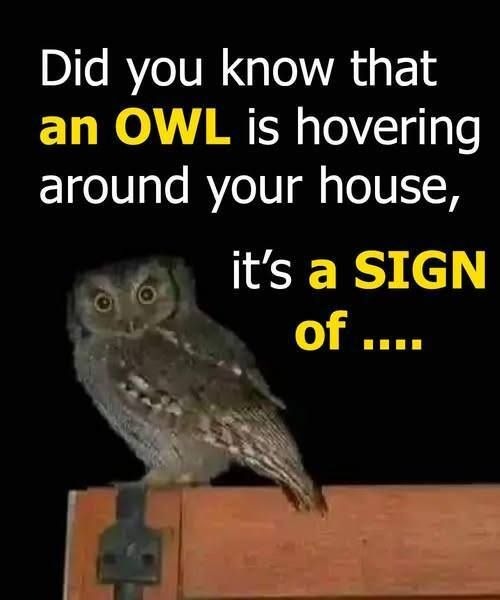
Did You Know an Owl Might Be Hovering Around Your House When You Least Expect It?
Late at night, when the world is quiet and the hum of daily life fades into the background, you might hear it—a soft hoo… hoo-hoo… drifting through the darkness. Or perhaps you catch a fleeting shadow gliding silently past a streetlight, wings stretched wide, disappearing before your eyes can fully register what you’ve seen.
For many people, the idea of an owl hovering around their house is both fascinating and unsettling. Owls have long been associated with mystery, wisdom, superstition, and the unseen world. Across cultures and centuries, their presence near human dwellings has sparked curiosity, fear, reverence, and countless stories passed down through generations.
But what does it really mean when an owl appears around your home? Is it a sign? A coincidence? A natural behavior? Or something more symbolic?
In this article, we’ll explore why owls come near houses, what their behavior actually means, the myths and beliefs surrounding them, and how you should respond if one is lingering near your home. By the end, you may see these nocturnal birds in an entirely new light.
Understanding Owls: Masters of the Night
Owls are among nature’s most efficient and enigmatic predators. Unlike most birds, they are primarily nocturnal, meaning they are active at night. Their bodies are perfectly designed for stealth:
Silent flight due to specialized feathers
Exceptional hearing, capable of detecting prey under snow or leaves
Large forward-facing eyes for enhanced depth perception
There are over 200 species of owls worldwide, and many of them have adapted surprisingly well to living near humans. While forests remain their preferred habitat, suburban neighborhoods, farms, and even cities can provide everything an owl needs to survive.
So if an owl is hovering around your house, the first thing to understand is this:
Your home might simply be part of its hunting ground.
Why Would an Owl Hover Around Your House?
1. Your Home Attracts Prey
Owls don’t come looking for people—they come looking for food.
Rodents such as mice, rats, voles, and squirrels are common owl prey. If your house or yard provides:
Garbage
Bird feeders
Gardens
Pet food left outside
…then you may be unknowingly hosting a buffet for small animals. And where prey goes, predators follow.
Streetlights and porch lights also attract insects, which attract rodents, which attract owls. To an owl, your well-lit yard might look like a late-night diner.
2. Trees, Roofs, and Poles Make Perfect Perches
Owls prefer high vantage points. Tall trees, rooftops, chimneys, fence posts, and utility poles around your house give them excellent places to perch and scan the ground for movement.
If you live near:
Wooded areas
Open fields
Farmland
Parks
…your house might simply fall within an owl’s natural territory.
3. Nesting Season Behavior
During breeding season, owls become more territorial and visible. They may:
Circle an area repeatedly
Vocalize more often
Appear to “hover” or glide back and forth
This is especially common in late winter and early spring. If an owl has chosen a nearby tree or structure as a nesting site, you may notice it more frequently during this time.
4. Juvenile Owls Learning to Hunt
Young owls often make awkward flights and may appear clumsy or curious. They are still learning how to hunt efficiently and may spend more time hovering, watching, and practicing.
If you see an owl behaving strangely or lingering longer than usual, it could simply be a teenager figuring out life.
The Silent Hover: Why Owls Seem to Float
Many people describe owls as “hovering,” but what they’re actually seeing is slow, controlled gliding. Because owls fly silently and smoothly, without the loud wing flaps of other birds, their movement can look supernatural.
Their wings are broad and specially fringed, reducing turbulence and sound. This allows them to approach prey without being detected—and gives humans the eerie impression that they’re floating through the air.
Cultural and Spiritual Meanings of Owls Near the Home
While science explains how and why owls behave the way they do, humans have always searched for deeper meaning in their presence.
Ancient Beliefs
Ancient Greece: Owls were sacred to Athena, goddess of wisdom. Seeing an owl was considered a blessing and a sign of intelligence.
Native American traditions: Beliefs vary by tribe. Some viewed owls as protectors or messengers, while others associated them with death or transformation.
Roman folklore: Owls were seen as omens, often tied to major events or changes.
African and Celtic traditions: Owls were linked to magic, hidden knowledge, and the spirit world.
Modern Spiritual Interpretations
Today, many people believe that an owl appearing near your house may symbolize:
Transformation or change
Heightened intuition
The need to pay attention to hidden truths
Protection or guidance
A message to slow down and observe
Importantly, these meanings are symbolic, not literal. An owl’s presence doesn’t predict death or disaster, despite common myths. More often, people interpret owl sightings during moments of personal transition or reflection.
Are Owls Dangerous?
This is a common concern, especially for families with pets or children.
To Humans
Owls are not dangerous to humans. They are shy and avoid confrontation. Attacks on people are extremely rare and usually only occur if someone approaches a nest too closely.
To Pets
Small pets like:
Chihuahuas
Kittens
Rabbits
could potentially attract an owl’s attention, especially at night. While attacks are uncommon, it’s wise to supervise pets outdoors after dark if owls are active nearby.
What Should You Do If an Owl Is Around Your House?
1. Do Nothing—and Enjoy It
Owls are protected wildlife in many regions. Watching one from a distance is a rare and beautiful experience. Their presence often indicates a healthy ecosystem.
2. Avoid Feeding or Interfering
Never attempt to feed an owl or approach it. Human interference can disrupt natural behavior and even harm the bird.
3. Secure Outdoor Pets at Night
If you’re concerned, keep small pets indoors after sunset or supervise them closely.
4. Reduce Rodent Attractions
If you don’t want owls hanging around:
Continue reading…
