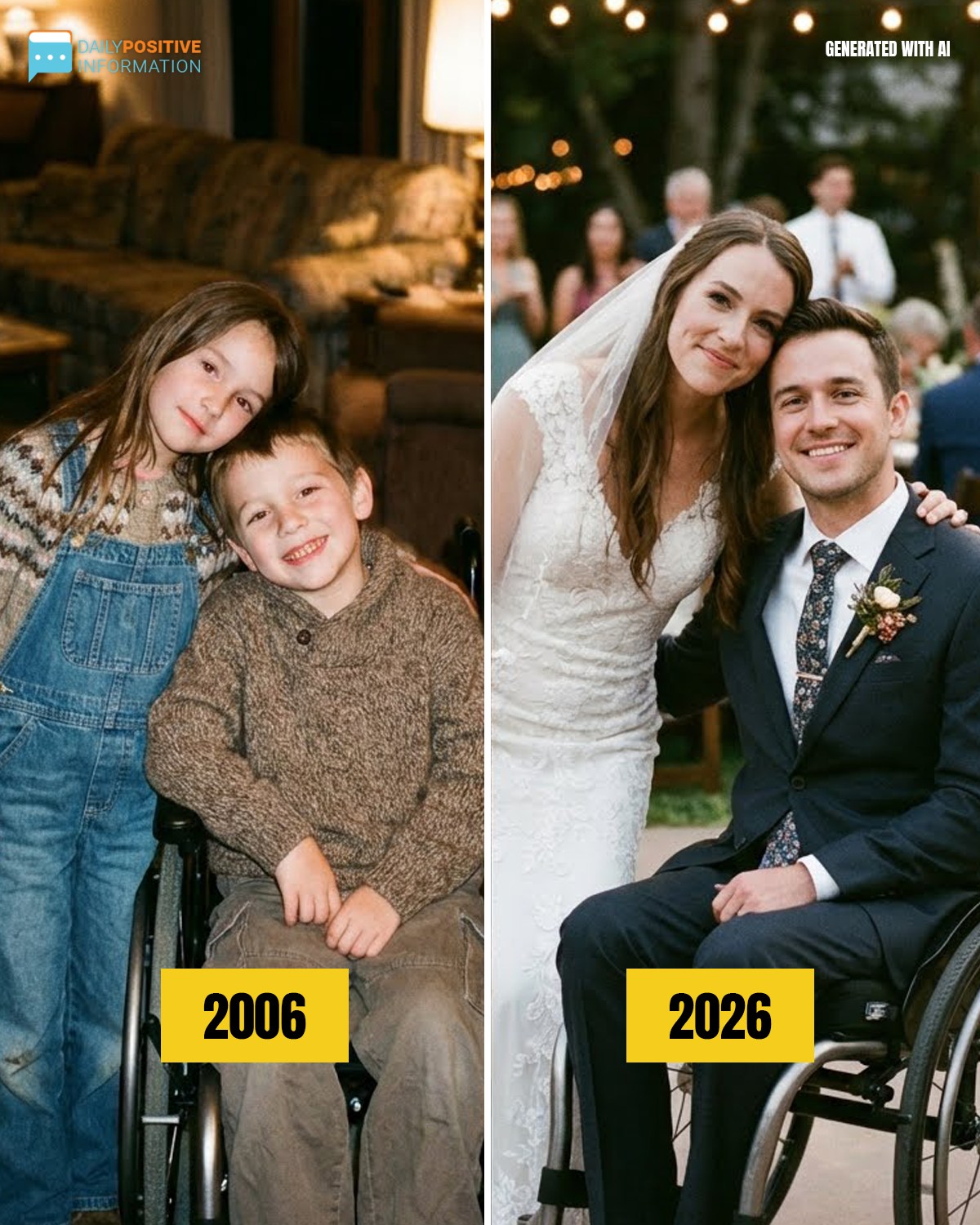
I Married The Boy I Grew Up With In An Orphanage — The Morning After Our Wedding, A Stranger Changed Everything
The orphanage smelled like boiled cabbage and floor cleaner, a scent so deeply embedded in my childhood that even now, twenty years later, it sometimes came back to me in dreams. The walls were a tired yellow, chipped and cracked in places, and the windows rattled whenever the wind blew too hard. It wasn’t a place anyone chose, but it was the place that raised us.
I was six when I arrived, clutching a small pink backpack that held everything I owned: two dresses, a pair of socks, and a photo of my mother smiling at the camera as if she knew I’d need that smile later to survive. I remember standing in the doorway, frozen, while the other children stared at me like I was an intruder in their world.
Daniel was the first one to come over.
He was eight, thin as a rail, with dark hair that never stayed combed and eyes too old for his face. He didn’t smile. He just held out a wooden toy car with one wheel missing.
“You can play with this,” he said. “It still rolls if you push it right.”
That was Daniel. He never promised perfection, only honesty.
We grew up side by side in that place. We shared chores, secrets, punishments, and dreams whispered under thin blankets long after lights-out. When other kids were adopted, one by one, we stayed. Every goodbye carved something out of us, but we learned not to show it.
Daniel became my protector. When boys teased me for crying too easily, he stood in front of me. When I had nightmares, he sat beside my bed until I fell asleep again. And when he was angry at the world—and he often was—I was the only one who could calm him down.
People used to joke that we were inseparable, like an old married couple. We laughed it off, but somewhere deep inside, I think we both knew.
“I’m going to marry you one day,” he said casually one night, skipping a stone across the cracked courtyard pavement.
I laughed. “You can’t just decide that.”
“Why not?” he asked, looking at me seriously. “You’re my family. You always have been.”
I didn’t answer, because I was afraid that if I did, I’d say yes too quickly.
Life, however, doesn’t move in straight lines. When we turned eighteen, we aged out of the system. I went to college on a small scholarship. Daniel took construction jobs, working with his hands until they were rough and scarred. For the first time in our lives, we were apart.
But we never let go.
We talked every day. Sometimes about nothing—what we ate, who annoyed us, what we missed. Sometimes about everything—fear, loneliness, hope. Years passed. We changed. But every time I saw him, it felt like coming home.
“I meant it,” he said. “Back then. I still mean it.”
I cried so hard I couldn’t speak. And when I finally nodded, he smiled in a way I’d never seen before—soft, almost disbelieving.
Our wedding was small but beautiful. No parents to sit in the front row, no childhood homes to return to afterward. But we had friends, a few former orphanage staff members, and something stronger than tradition: shared history.
The morning after our wedding, I woke up tangled in white sheets, sunlight spilling across the room. Daniel was asleep beside me, his arm heavy around my waist. For a moment, I just lay there, breathing him in, feeling an unfamiliar sense of safety.
We did it, I thought. We survived. We built something.
There was a knock at the door.
Daniel groaned and pulled the pillow over his head. “Ignore it.”
Another knock. Firmer this time.
I slipped out of bed, wrapped myself in a robe, and went to the door. I expected a hotel staff member or maybe one of our friends who had stayed nearby.
Instead, I found a man in his late fifties standing in the hallway.
He was well-dressed, gray-haired, with eyes that widened the moment he saw me.
“Is Daniel here?” he asked, his voice unsteady.
Something about him made my stomach tighten. “Who’s asking?”
“My name is Michael Harris,” he said. “I need to speak with him. It’s… important.”
I hesitated, then opened the door wider. Daniel appeared behind me, shirtless and sleepy.
The man’s face crumpled.
“Oh my God,” he whispered. “It’s you.”
Daniel straightened instantly. “Do I know you?”
Michael swallowed hard. “I think I’m your father.”
The word hit the room like a dropped plate.
I turned to Daniel, whose face had gone completely blank. “That’s not funny,” he said coldly.
“I know,” Michael replied. “And I wouldn’t be here if I wasn’t sure.”
Daniel laughed, sharp and humorless. “I grew up in an orphanage. No parents. No visitors. No explanations.”
Michael nodded. “Because I failed you.”
He asked to come in. Against every instinct, we let him.
Michael told us a story that unraveled everything Daniel thought he knew. He had been young, reckless, in love with a woman who struggled with addiction. When she disappeared shortly after Daniel was born, Michael searched—but not hard enough, not long enough. By the time he learned Daniel had ended up in the system, years had passed. Legal barriers, fear, and guilt stopped him from trying again.
“I told myself you were better off without me,” he said, tears streaming down his face. “But that was a lie I used to live with myself.”
Daniel said nothing. His fists were clenched so tightly his knuckles were white.
Then Michael said the sentence that changed everything.
“There’s something else you need to know,” he said quietly. “About you… and about her.”
He looked at me.
My heart dropped. “About me?”
Michael nodded. “Your mother… her name was Elena, wasn’t it?”
The room began to spin.
“How do you know my mother’s name?” I whispered.
Michael closed his eyes. “Because she was my sister.”
Silence swallowed us whole.
Daniel stepped back as if struck. “No,” he said. “That’s not possible.”
“You and Lily are cousins,” Michael said. “First cousins.”
The words felt unreal, like dialogue from a bad dream. I couldn’t breathe. My legs gave out, and I sank onto the couch.
“We grew up together,” Daniel said hoarsely. “In the same orphanage.”
“I know,” Michael said. “I didn’t know about Lily until recently. When I started looking for you, I found records. Two children from the same family line, separated, lost.”
I felt sick. My entire life flashed before me—every shared secret, every touch, every promise. Our wedding. The vows we’d spoken with absolute certainty.
Continue reading…
