A childhood in another world
Jeanne Louise Calment was born on February 21, 1875, in Arles, a sun-drenched town in the south of France. At the time, France was still healing from the Franco-Prussian War, and life moved at a pace that would feel impossibly slow to us now. Electricity was rare, cars were nonexistent, and most people lived and died within a small geographic radius. Jeanne grew up in a comfortable, bourgeois family—her father was a shipbuilder and her mother came from a milling family—meaning she enjoyed relative stability and education compared to many of her contemporaries.
From a young age, Jeanne seemed comfortable observing the world rather than rushing through it. She attended school, learned to play the piano, and lived a life shaped by routine, community, and sunlight. There was no indication she would one day become the most famous supercentenarian in recorded history—but perhaps that’s the point. Longevity, as her life suggests, doesn’t always announce itself early.
Marriage, motherhood, and loss
At 21, Jeanne married her second cousin, Fernand Calment, a wealthy shop owner. Because of his financial success, Jeanne never needed to work outside the home, which gave her the freedom to pursue hobbies like fencing, cycling, swimming, roller skating, and tennis—activities she continued well into midlife. This physical engagement, casual rather than obsessive, would later become one of the many factors people pointed to when trying to explain her extraordinary lifespan.
The couple had one child, a daughter named Yvonne. Tragedy struck when Fernand died in 1942 after eating spoiled cherries, and even greater heartbreak followed when Yvonne died in 1934 from pneumonia. Jeanne outlived both her husband and her only child—an emotional burden that many long-lived individuals carry. Longevity is often romanticized, but Jeanne’s life reminds us that living longer also means saying goodbye more often.
After Yvonne’s death, Jeanne helped raise her grandson, Frédéric. When he too died in a car accident in 1963, Jeanne was left without direct descendants. Still, she continued living independently in her apartment in Arles, surrounded by familiar streets and memories, refusing to surrender her autonomy.
The famous deal: outliving expectations
One of the most astonishing episodes of Jeanne’s life occurred when she was 90 years old. In 1965, she entered into a legal agreement known in France as a viager with a local lawyer, André-François Raffray. He agreed to pay her a monthly sum in exchange for inheriting her apartment upon her death. At the time, it seemed like a safe bet—after all, she was already 90.
Except Jeanne didn’t die.
It’s hard not to admire the quiet rebellion in that story. Jeanne didn’t “beat” the system intentionally—she simply kept living, calmly and unapologetically, while the world tried to predict her end.
Habits that shocked the world
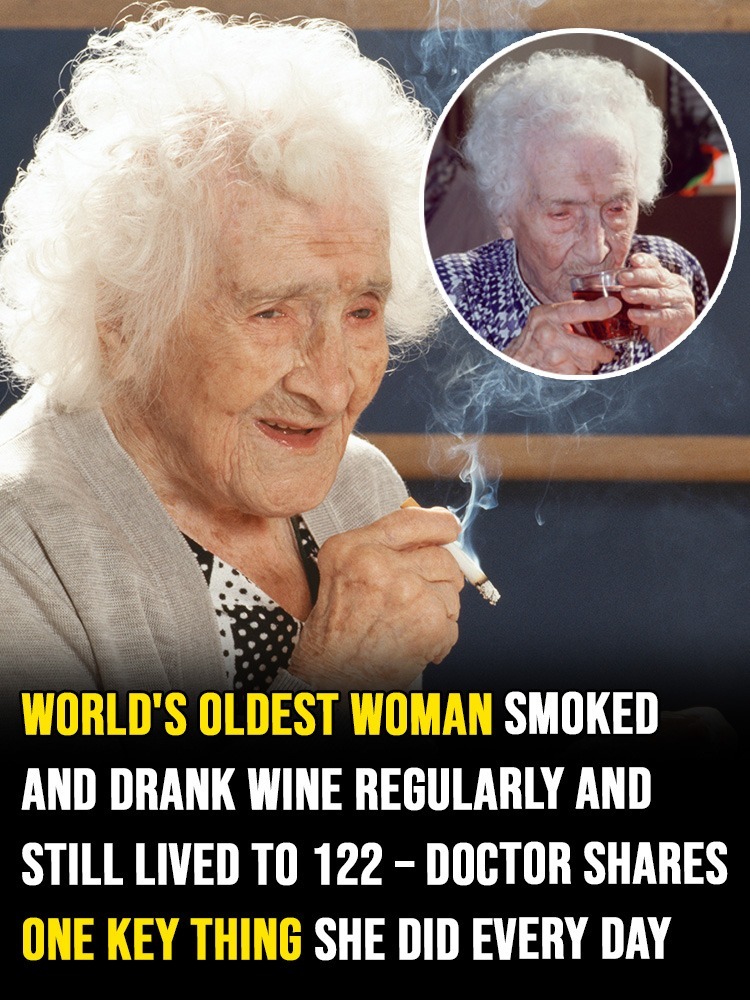
When Jeanne turned 120, the global media descended on Arles, desperate to uncover the secret of her longevity. What they found baffled and delighted them. Jeanne smoked cigarettes—lightly, but consistently—from her youth until she was 117. She drank wine regularly. She enjoyed chocolate, often eating it daily. Olive oil was a staple in her diet, used both in cooking and reportedly on her skin. She never followed a strict exercise regimen or a modern health philosophy.
To many, she became a walking contradiction of everything we’re told about aging well.
But Jeanne herself rejected the idea that her habits needed defending. When asked about her lifestyle, she often responded with humor and indifference. She credited her long life to olive oil, laughter, and a general lack of worry. “I’ve only had one wrinkle,” she once said, “and I’m sitting on it.”
What stands out is not that she smoked or drank wine, but that she did so without guilt, obsession, or stress. Her habits were woven into a broader philosophy of moderation, pleasure, and emotional resilience. She didn’t chase longevity—she lived her life, and longevity followed.
Mind over years
Her attitude toward aging was refreshingly unsentimental. She did not romanticize youth or fear death. When asked if she was afraid of dying, she calmly replied that she was waiting for it with curiosity. Aging, for her, was not an enemy—it was simply a continuation.
This mental resilience may be one of the most important clues to her longevity. Chronic stress, bitterness, and anxiety take a real toll on the body. Jeanne, by contrast, seemed to let life flow through her rather than pile up inside her. She accepted loss, adapted to change, and maintained a sense of humor even as the years stacked impossibly high.
The science and the skepticism
Jeanne Calment’s age has been rigorously studied and verified by demographers, making her the oldest person with fully validated documentation. Birth records, census data, marriage certificates—all aligned to support her claim. Still, in recent years, some controversy emerged, with fringe theories suggesting identity substitution. These claims have been widely criticized and rejected by mainstream researchers, who continue to stand by the original verification.
Why does this matter so much? Because Jeanne represents the outer edge of human lifespan as we currently understand it. Scientists studying aging look to cases like hers to explore genetic factors, cellular resilience, and lifestyle patterns that might push the boundaries of what’s possible.
Yet Jeanne herself was uninterested in being a scientific specimen. She didn’t believe she was special. She believed she was lucky.
Living in the south of France
It’s impossible to separate Jeanne Calment from the place she lived. Arles, with its warm Mediterranean climate, slow rhythms, and strong sense of community, likely played a role in her longevity. She walked daily, soaked up sunlight, and lived among people who knew her as more than a curiosity.
The southern French lifestyle—rich in social connection, fresh food, and daily movement—aligns with what we now associate with longevity “blue zones.” But Jeanne’s life shows that environment alone isn’t enough. It’s how you inhabit that environment that matters.
She didn’t rush. She didn’t isolate herself. She didn’t define herself by productivity or achievement. She simply lived, day after day, allowing life to accumulate rather than burn out.
Continue reading…
