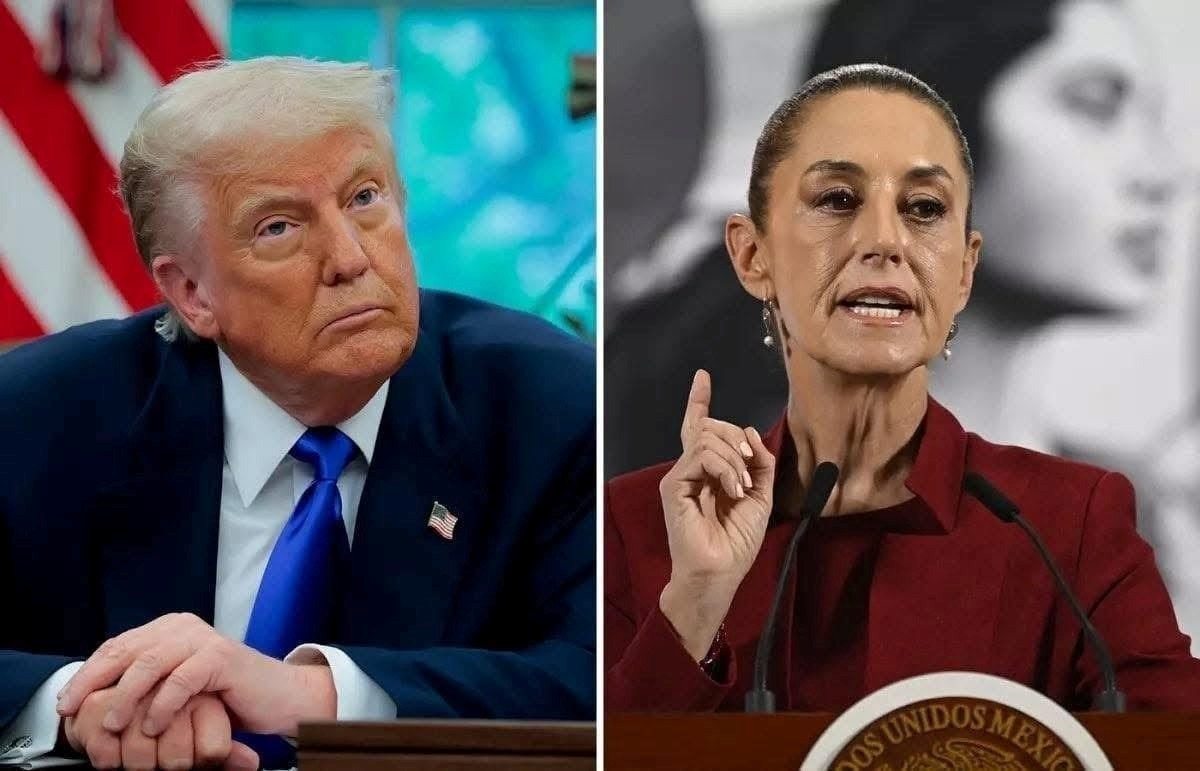
🇲🇽 Background: Mexico–U.S. Relations Under Sheinbaum and Trump
Since Donald Trump regained the U.S. presidency in January 2025, relations between Mexico and the United States have been a mix of close cooperation on trade and escalating friction on security and sovereignty issues.
Economically, the United States‑Mexico‑Canada Agreement (USMCA) remains a central pillar of bilateral relations, and both governments are officially engaging in its scheduled joint review. Trump has called USMCA “irrelevant” in some contexts, prompting a formal response from Sheinbaum insisting on its importance.
At the same time, Mexico has reaffirmed its sovereign right to manage economic decisions — such as the temporary pause in oil shipments to Cuba — even amid U.S. pressure to align with Washington’s regional strategies.
🧨 Trump’s Rhetoric on Mexico and the “Cartels”
One of the major drivers of tension is Trump’s repeated criticism of Mexico’s handling of drug cartels. He has publicly stated — in interviews and press settings — that:
Mexico is “governed in large part by cartels,” implying the Mexican government lacks control.
He has suggested the U.S. may need to take action against cartels inside Mexico if Mexico does not act — language that both escalates tensions and raises constitutional questions about sovereignty.
On some occasions, Trump has portrayed the cartels as so powerful that they overshadow the Mexican state itself.
This hardline messaging contrasts sharply with Mexico’s insistence that any action against cartels must respect Mexican sovereignty.
One of Sheinbaum’s most significant rebukes of Trump is her insistence that the United States will never be allowed to conduct unilateral military operations on Mexican soil — even if proposed as assistance to combat cartels.
Sheinbaum has publicly stated that:
“We will never accept joint operations by the United States … operations on our territory are carried out by Mexican forces … we always tell President Trump that.”
This amounts to an effective statement that Trump is not permitted to send U.S. troops into Mexico to pursue cartels — a clear defense of national sovereignty rooted in Mexico’s constitution and long‑standing diplomatic principle of non‑intervention.
Sheinbaum: “Trump Is Not Going to Intervene Militarily in Mexico”
During press conferences, Sheinbaum reiterated that no U.S. intervention will take place in Mexico without explicit consent — a rejection of Trump’s suggestion that U.S. forces might enter to fight criminal groups.
Her tone is firm: Mexico’s land and sovereignty are inviolable, and Trump’s threats or suggestions of military action are not going to materialize without Mexican agreement.
While there isn’t one perfect quotation along the lines of “[X], Trump is not …”, the consistent message from Sheinbaum to Trump across multiple settings — press conferences, diplomatic statements, presidential calls — is:
“Trump is not allowed to deploy U.S. forces in Mexico.”
“Trump will not unilaterally conduct operations on our territory.”
“Joint operations must respect Mexican command — U.S. agencies can share intelligence, but not independently act.”
These position statements have been repeatedly emphasized by Mexican officials and underscore a major diplomatic threshold: U.S. security cooperation must respect Mexican command and control.
📞 Recent Communications Between Sheinbaum and Trump
📅 January 29, 2026 Call
On January 29, 2026, Sheinbaum and Trump held a 40‑minute phone call described as “productive and cordial,” covering security and trade cooperation in the context of the USMCA review. Sheinbaum restated her nation’s position that:
Mexico will not accept U.S. joint law enforcement or military operations on its soil.
Collaboration is welcome, but U.S. forces may not operate inside Mexico without consent.
Trump publicly thanked her for her leadership and emphasized that the conversation was constructive. However, the underlying tension on sovereignty and cartels remains unresolved.
🧠 Why This Matters
1. Sovereignty and National Pride
For Mexico, defending against unilateral foreign military action is a non‑negotiable principle rooted in historical struggles against intervention and colonialism. Sheinbaum’s repeated emphasis on this point signals a firm commitment to sovereignty that resonates domestically and internationally.
2. Security Cooperation vs. Intervention
While Mexico and the U.S. share concerns about drug trafficking and fentanyl production, the two governments disagree sharply on how to cooperate:
The U.S. wants more direct, possibly kinetic involvement.
Mexico wants data sharing, coordinated policy, and support without boots on the ground.
This divide reflects deeper questions about mutual trust and the limits of sovereign authority in cross‑border security.
3. Domestic Political Considerations
Sheinbaum’s stance plays well politically in Mexico, reinforcing national identity and resisting narratives that Mexico is incapable of governing its own security affairs. Trump’s rhetoric, on the other hand, feeds into narratives of weakness and constraint — which the Mexican government actively counters.
Continue reading…
