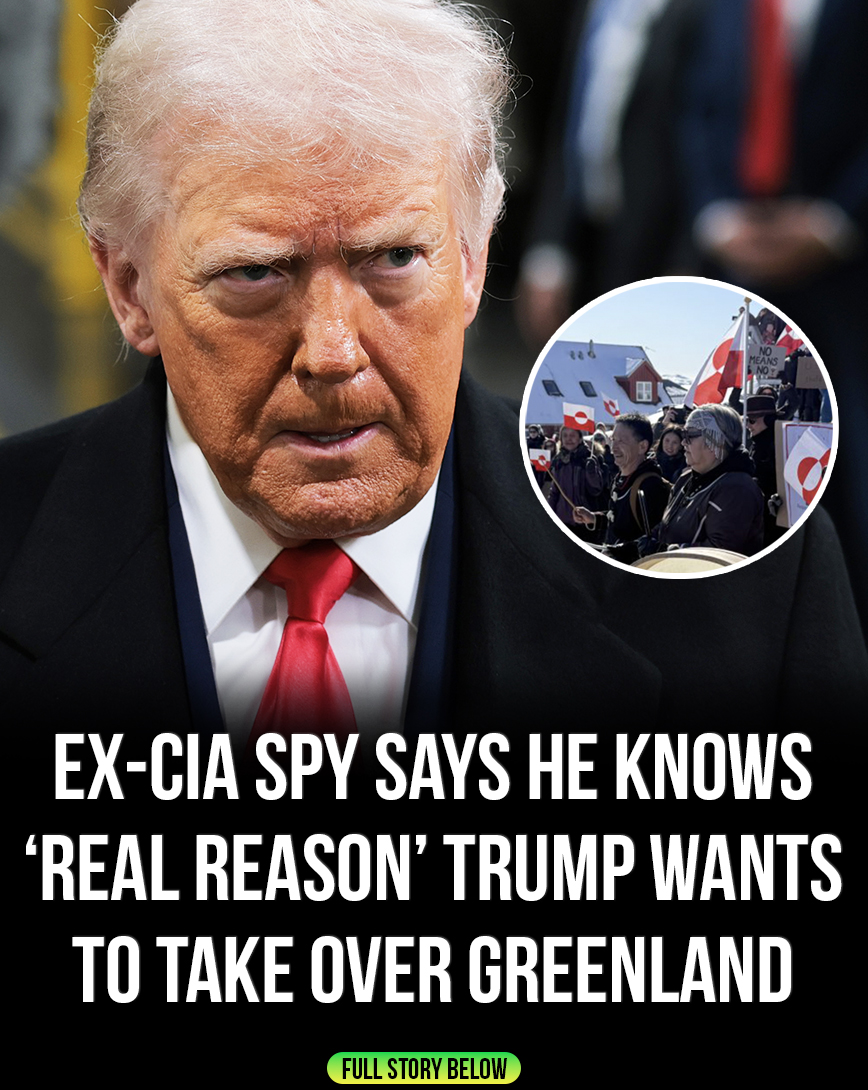
Why Is Trump So Focused on Greenland? (And What the “Former CIA Spy” Claim Actually Says)
On January 20, 2026, several online outlets reported that a former CIA operative claimed to know the “true reason” President Donald Trump wants to take over Greenland — an idea that many commentators have called unusual or controversial.
1) What the Former CIA Operative Claimed
According to the article reporting this statement, the former CIA analyst — identified as Andrew Bustamante — argues the “true reason” Trump is fixated on Greenland revolves around power, resources, and Arctic dominance:
He suggests Trump sees American dominance in the Arctic as critical to U.S. primacy and geopolitical leverage.
Bustamante’s view is framed as explaining motivations “beyond what’s publicly acknowledged,” including strategic and resource competition.
Key caveat:
This interpretation comes from a media article summarizing the former operative’s comments, and not directly from a published intelligence assessment or official interview. That means his analysis is opinion rather than authenticated classified insight.
2) Trump’s Public Reasoning: Security, Geopolitics, and Strategic Competition
When Trump has publicly discussed Greenland, his stated official reasons fall into several recurring themes — sometimes consistent with global strategic logic, and at other times more personal:
A. National and Global Security Claims
He claims that controlling Greenland would be critical for “national security” and “world peace” because of its strategic location between North America and Europe.
He suggested that if the U.S. doesn’t secure control, Russia or China might.
This interpretation aligns with conventional geopolitical thinking: Greenland sits at the gateway to the Arctic — a region of growing military and commercial significance as ice melts and new sea routes and infrastructure emerge.
B. Strategic Military Value
The U.S. already maintains a major military presence in Greenland through the Pituffik Space Base and other facilities.
Control over Greenland could:
Expand Arctic early‑warning systems,
Give the U.S. greater surveillance and logistical reach over the Arctic.
Trump has also pushed for U.S. sovereignty over base areas within Greenland — a model compared to British sovereign base areas — without wholly annexing the island.
C. Economic and Resource Considerations (Rare Earths, Oil, Minerals)
Greenland contains large deposits of rare earth minerals, uranium, copper, nickel, lithium, and other resources — all increasingly valuable for advanced electronics, renewable energy technologies, and military systems.
Many analysts see access to these resources as a major underlying factor in U.S. interest — even if the official rhetoric remains more focused on security.
D. Personal or Psychological Motivation (Trump’s Own Words)
In an interview, Trump said ownership of Greenland was “psychologically important” — suggesting that his motivations may include personal or symbolic factors beyond cold strategic logic.
His phrasing underscores how his own framing differs from typical diplomatic language — mixing geopolitical rationale with personal emphasis.
3) The Broader Geopolitical Context: Greenland as a Prize in Global Competition
To understand why Greenland is significant beyond U.S. domestic politics, consider the broader global context:
A. Arctic Geopolitics Is Heating Up
As sea ice diminishes due to climate change, the Arctic — including Greenland — is becoming a strategic corridor for:
New maritime shipping routes that could shorten transit between East Asia and Europe,
Access to untapped natural resources,
Military and intelligence basing.
Global powers like Russia and China have ramped up investment and activity in the region — which the U.S. and NATO see as strategic.
B. U.S. Presence Has Historical Roots
The U.S. already maintained a strong military presence during the Cold War and continues to operate a space and missile early‑warning base in Greenland — reflecting decades‑long strategic interest.
C. Competition With China
Control or influence in Greenland also intersects with U.S.–China rivalry — especially over rare Earths and Arctic access. Analysts believe mineral wealth in the far north will be vital for future technology and defense industries, an arena where China currently dominates global production.
4) Why This Is Controversial — and Why Many Experts Reject the Takeover Idea
While Trump’s statements and some commentators frame the issue as urgent, several legal, diplomatic, and practical realities constrain the idea of the U.S. “taking over” Greenland:
A. Sovereignty and International Law
Greenland is a semiautonomous territory of Denmark, and Denmark has made clear that Greenland is not for sale and won’t be ceded.
Taking control of Greenland — by force or otherwise — would violate international law and would have severe diplomatic repercussions.
B. NATO and European Opposition
Senior European leaders and NATO officials have pushed back strongly, warning that any attempt to undermine Danish sovereignty could undermine NATO itself. Former NATO Secretary General Anders Fogh Rasmussen said so explicitly.
C. Workarounds vs. Full Annexation
While outright territorial acquisition is widely rejected, there are areas where compromise might be possible — such as:
Expanded U.S. access rights,
Increased military cooperation,
Arctic defense partnerships.
These would allow heightened U.S. strategic influence without political sovereignty.
5) U.S. Domestic Debate and Divergent Narratives
The debate in the U.S. — including among policymakers, media, and analysts — divides into several camps:
Proponents (Strategic Security Frames)
Supporters emphasize:
The Arctic’s future strategic importance,
Preventing rival powers (China/Russia) from gaining influence,
Strengthening missile defense and surveillance capabilities.
Critics (Diplomacy and Rule of Law)
Critics argue:
Direct takeover rhetoric is inflammatory and unlawful,
It risks damaging NATO and U.S. alliances,
It distracts from other pressing global concerns.
Skeptics (Personal/Media Interpretation)
Some voices — whether in media analysis or casual commentary — question whether the rationale is genuinely strategic or instead reflects Trump’s personal style and negotiation tactics.
6) What the “CIA Spy” Claim Adds — and What It Doesn’t
The Newsner article’s claim that a former CIA operative “knows the true reason” tends to amplify broader interpretations that have circulated in public debate — especially strategic dominance, resource competition, and geopolitical leverage.
But it’s important to be clear:
This is commentary, not classified intelligence — and intelligence analysts routinely share opinions once they leave active service.
It complements public analysis but does not reveal any secret plan unknown to governments or analysts.
Trump’s own public statements — including about geopolitics, psychology, and defense — suggest that multiple factors are being discussed openly.
So the “true reason” claim mostly reflects one interpretation among many, not a definitive classified conclusion.
7) Final Assessment: Mixed Motives in a Complex Geopolitical Puzzle
Here’s a balanced synthesis:
Likely Genuine Factors
Strategic military value — Greenland is crucial for Arctic defense and early warning systems.
Resource competition — Greenland’s minerals are vital for future technology.
Geopolitical rivalry — Arctic influence amid China and Russia’s interest.
Contested or Weak Factors
Personal psychological motivation — Trump has emphasized this publicly, but it’s more personal framing than strategic doctrine.
Justification of military force — Trump has said force is an “option,” but later ruled it out as a policy.
Unrealistic or Ill‑Advised Proposals
Forcible takeover — Massively destabilizing legally and diplomatically.
Ignoring allies and NATO norms — Likely to backfire diplomatically.
8) Broader Implications and What Comes Next
The Greenland debate highlights larger global trends:
Continue reading…
