Vision Tests That Go Viral
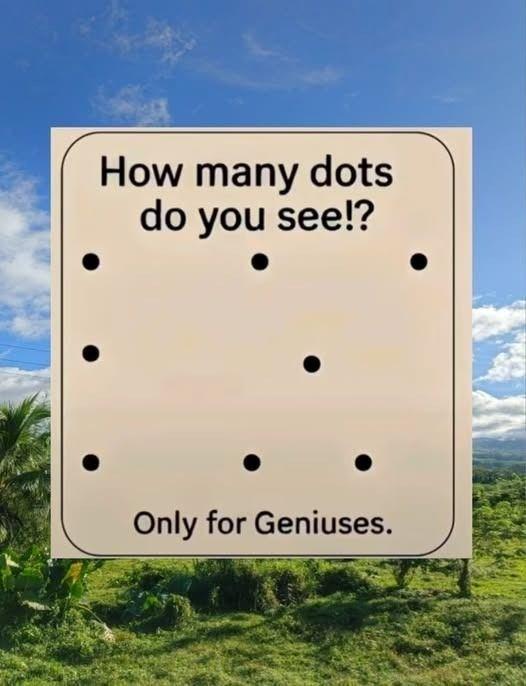
In recent years, images that ask “How many dots do you see?” have been shared widely on social media as playful tests of eye sharpness or perception. On the surface, these look like simple puzzles — just count dots — but scientifically they tap into visual perception, brain processing, and sometimes even eye health issues. People often assume that if you see more or fewer dots, it says something about your eyesight. But what’s really going on?
👁️🗨️ 1. What Are These “Dot” Tests?
Tests like “How many dots do you see?” are a type of optical illusion — visual stimuli designed to trick or challenge your visual system and brain. They often involve patterns that make your eyes struggle to detect all the dots at once.
The most common versions include:
🔸 Black Dot Grid Illusion
A grid of gray lines on a white background with small black dots at the intersections. You’re asked how many dots you see. Many people see fewer dots than there actually are — often only a few at a time — even though the dots are physically present.
🔸 Hidden Number Dot Pattern
A colored pattern with random dots that collectively form a number (like 571 or 409) in the middle. Depending on contrast and individual visual acuity, people report seeing different numbers or nothing at all.
🔸 Multiple‑dot challenges
These puzzles are playful and fun — but they are not formal eye exams.
🧠 2. The Brain’s Role: Why We Don’t Always See All Dots
To understand why these puzzles work, we need to look at how vision and perception function:
👁️ 2.1 Visual Processing Is More Than Just the Eyes
When light reaches your eyes, they convert it into electrical signals sent to your brain. What you see is actually your brain’s interpretation of those signals. This means perception isn’t just about visual sharpness — it’s about attention, focus, and prediction.
Your visual system is constantly filtering, filling in gaps, and even “guessing” what should be there based on patterns. Optical illusions exploit this.
👁️ 2.2 Peripheral Vision and Blind Spots
🔹 Clean Focus vs. Peripheral Vision
When you stare directly at one point, your fovea (a tiny part of the retina responsible for sharp central vision) picks up detail. But the dots around that focus are processed by your peripheral vision — which is weaker for small details.
In illusions like the grid of black dots, you may only see a few clearly at once because the others sit in your peripheral field where detail resolution is low.
🔹 Brain Filling in Gaps
Your brain also fills in areas your eyes don’t capture precisely based on surrounding patterns. That’s why dots sometimes appear to disappear — the brain “thinks” it knows what’s there without actually processing every dot.
So the test is really about visual attention and perceptual processing, not just “sharpness”.
👓 3. Eye Tests vs. Optical Illusions
There’s an important difference between playful dot illusions and medically valid eye examinations.
✔️ 3.1 False Leads: What Dot Count Illusions Do
• Stimulate curiosity and debate online.
• Engage pattern recognition and attention.
• Can reveal differences in individual perception.
But they:
❌ Are not standardized.
❌ Do not measure visual acuity or eye health.
❌ Are not clinically validated.
So if you see fewer or more dots than someone else, it doesn’t mean your eyesight is “better” or “worse”.
⚕️ 3.2 Legitimate Visual Tests
True clinical eye tests include:
🔹 Ishihara Color Plates
These plates use colored dots to form numbers that detect color vision deficiencies like red‑green blindness. Only some viewers with normal color vision see the “correct” number.
🔹 Amsler Grid
A grid with central dot used to check for retinal issues like macular degeneration. Patients focus on the dot; distortions or missing lines indicate vision problems.
🔹 Worth Four‑Dot Test
Used clinically to assess binocular vision — whether both eyes are working together or one is suppressed. The test uses red/green filters and dots to determine how many lights a person perceives.
🧪 4. How Dot Illusions Test Perception
While they aren’t medically validated, dot illusions still say something interesting about how our brains work…
🧠 4.1 Demonstrating Peripheral Limitations
As mentioned, images like the 12‑dots grid (viral online) show that most people cannot see all dots at once — even though all dots are physically present.
Researchers and psychology enthusiasts often use this example to explain visual perception and the limitations of peripheral vision.
👀 4.2 Attention, Focus, and Cognitive Load
Some people may count more dots because they:
✔ Move their eyes systematically across the image.
✔ Use better scanning strategies.
✔ Take their time to process each area.
Others see fewer because they glance without systematic focus.
The brain only dedicates high‑resolution processing to the center of gaze, blending or ignoring details in periphery. So the dot count can vary widely even among people with similar visual acuity.
🎯 4.3 Effects of Presentation
How the image is shown also matters:
📌 Screen size and resolution
📌 Distance from eyes
📌 Lighting
📌 Image contrast
All can affect how many dots you think you see — another reason why these are not reliable vision tests.
🔬 5. The Science Behind Popular Dot Illusions
Let’s examine some well‑known variants in more detail.
🖼️ 5.1 Spot the Hidden Number (e.g., 571, 409)
These patterns are similar to color blind test plates or camouflage illusions:
• Thousands of dots of varying color shade form a hidden number.
• If your contrast sensitivity and color interpretation are good, you can pull out the number from the noise.
Most people see the number if they look long enough and adjust their focus or perception technique.
🟢 5.2 Count All the Black Dots
This type of illusion usually has 12 black dots at intersections of grey lines. Only a few appear at once because:
✔ The grey grid distracts and fills in.
✔ Peripheral vision doesn’t pick up dot details as clearly.
✔ The grid’s structure triggers brain inference processes.
The dots are really there, but your brain often completes the pattern of grid lines and “ignores” the black dots you aren’t directly looking at.
This effect is related to classic phenomena like the Hermann grid illusion, where spots appear and disappear at intersections due to how the visual system processes contrast and light.
🧩 6. Perception vs. Acuity: What Exactly Are We Measuring?
People sometimes assume these puzzles test sharpness or acuity. But most measure:
🔹 Perceptual Attention
How well you scan and attend to complex images.
🔹 Cognitive Interpretation
Whether your brain picks up patterns in a noisy visual field.
🔹 Contrast Sensitivity
Your eyes’ ability to distinguish small color or shade differences.
They do not reliably measure:
❌ Snellen visual acuity (standard “20/20” test)
❌ Depth perception
❌ Refraction errors (nearsighted/farsighted)
❌ Eye muscle coordination
🧠 7. Why Some People “See More”
Why do some people count more dots or see the hidden number faster?
Possible influences include:
🔹 Better attention to detail
🔹 More methodical scanning strategies
🔹 Familiarity with optical illusions
🔹 Higher contrast sensitivity
🔹 Screen/viewing conditions
None of these directly indicate better eyesight in the medical sense.
🤔 8. What Your Result Doesn’t Mean
Seeing more dots doesn’t necessarily mean:
❌ You have better visual acuity
❌ You have superior eye health
❌ Your eyes are stronger than others’
Conversely, seeing fewer doesn’t imply:
Continue reading…
