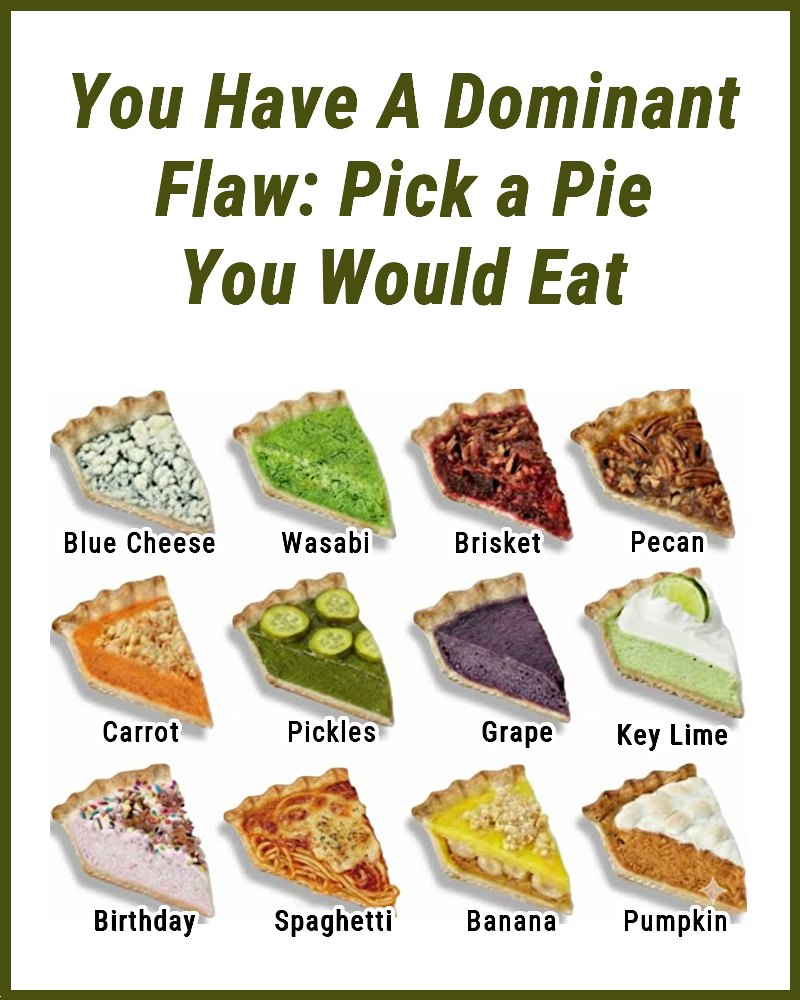
You Have a Dominant Flaw: Pick a Pie You Would Eat
We all like to believe we’re complicated. Layered. Nuanced. A rich inner universe of contradictions and depth. And to be fair—we are. Humans are messy, contradictory creatures capable of both great kindness and impressive self-sabotage.
Not the worst thing we’ve ever done.
Not the trauma we carry.
Not the label we’d put on ourselves during a moment of self-loathing.
A dominant flaw is subtler than that. It’s the default setting. The thing that shows up when we’re tired, stressed, comfortable, or unchecked. It’s the lens through which we interpret the world—and the way we trip over ourselves again and again, even when we know better.
And weirdly enough?
You can learn a lot about that flaw by asking a very simple, very unserious question:
What kind of pie would you choose to eat?
Not your favorite dessert in theory.
Not the pie that sounds impressive.
Not the one you think says something good about you.
The one you’d actually pick. Instinctively. Comfortably. Without overthinking it.
Because pie, like people, is never just pie.
Pie is intimate.
Cake is for birthdays. It’s performative. Frosted. Loud. Designed to be seen. Pie, on the other hand, is quieter. Pie shows up at family tables, holidays, late-night kitchens, and diners at 2 a.m. Pie is comfort without spectacle.
Pie doesn’t try to impress you.
It just wants to be chosen.
And that’s exactly how dominant flaws work.
They’re not dramatic personality disorders or obvious red flags. They’re the things we default to because they’re familiar. Comfortable. Reassuring in a twisted way.
Your pie choice isn’t about taste alone. It’s about:
What you crave when no one is watching
Whether you lean toward safety, intensity, nostalgia, control, indulgence, or escape
So let’s talk about the pies—and what they quietly reveal.
Apple Pie: The Flaw of Playing It Safe
Apple pie people are rarely accused of being difficult.
They’re reliable. Predictable. Pleasant. They know how to show up, follow rules, and do what’s expected. They’re often liked by many and deeply known by few.
The dominant flaw here is avoidance through normalcy.
Apple pie choosers often mistake being inoffensive for being authentic. They value stability so much that they sometimes abandon their own complexity to preserve harmony. They don’t rock the boat—not because they don’t have opinions, but because rocking the boat feels like unnecessary risk.
Their flaw isn’t fear exactly.
It’s self-erasure disguised as maturity.
They’ll say:
“I’m just easygoing.”
But what they mean is:
“I don’t want to deal with the fallout of wanting more.”
Apple pie people struggle with resentment later in life—not because they were wronged, but because they kept choosing what was acceptable over what was true.
Chocolate Cream Pie: The Flaw of Emotional Indulgence
Chocolate cream pie is rich, soft, comforting, and a little excessive.
People who choose it tend to feel things deeply. They chase emotional highs and sink hard into emotional lows. They don’t just experience sadness—they marinate in it. They don’t just enjoy pleasure—they lean into it with both arms.
The dominant flaw here is emotional overidentification.
Chocolate cream pie people often confuse intensity with authenticity. If something doesn’t feel deep, dramatic, or consuming, they assume it doesn’t matter.
Their internal logic is:
“If it doesn’t move me, it must not be real.”
But not everything meaningful is overwhelming. Not every healthy connection is explosive. Sometimes calm is just calm—not empty.
Their flaw shows up when they:
Stay too long in emotional pain because it feels familiar
Romanticize suffering
Mistake chaos for passion
They don’t need more feeling.
They need more discernment.
Pumpkin Pie: The Flaw of Living in the Past
Pumpkin pie isn’t about flavor—it’s about memory.
It tastes like holidays, family traditions, specific kitchens, specific people. Pumpkin pie choosers are often deeply sentimental. They attach meaning to objects, rituals, and shared moments.
Continue reading…
