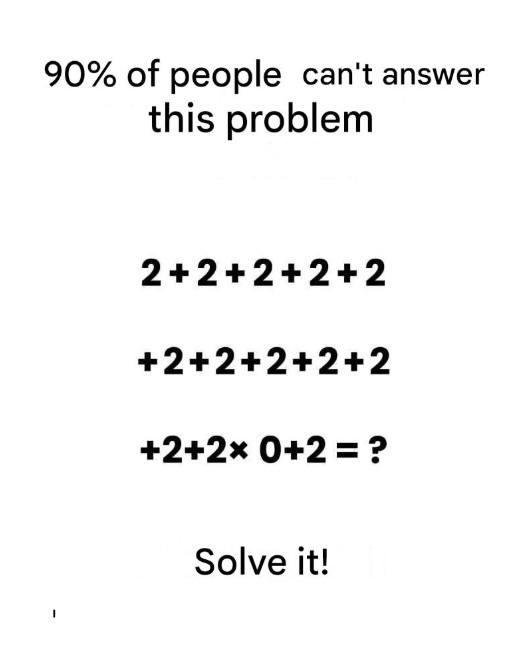
Let’s solve it carefully:
Let the cost of the ball be x dollars.
Together, they cost $1.10.
So, we can write the equation:
𝑥
+
(
𝑥
+
1
)
=
1.10
x+(x+1)=1.10
Combine like terms:
2
𝑥
+
1
=
1.10
2x+1=1.10
Subtract 1 from both sides:
2
𝑥
=
0.10
2x=0.10
Divide by 2:
✅ The ball costs 5 cents, not 10 cents.
Why Do 90% of People Get It Wrong?
This is where it gets fascinating. The problem taps into something called cognitive reflection, a psychological concept that measures how much people override their gut instincts to engage in deeper reasoning.
System 1 thinking: Fast, intuitive, automatic. The first answer (“10 cents”) comes from here.
System 2 thinking: Slow, deliberate, logical. Solving it step by step requires engaging this system.
Many people default to System 1, especially when the numbers seem “obvious.”
The Power of Intuition
Evolutionary perspective: Fast mental shortcuts, or heuristics, helped our ancestors survive by quickly assessing threats or opportunities.
Modern downside: These heuristics aren’t always accurate for abstract problems like math puzzles.
The bat-and-ball problem is deceptively simple, yet it exposes the tension between intuition and analysis.
Other Examples of Deceptively Simple Problems
This problem isn’t unique. Other puzzles reveal the same cognitive blind spots:
The Monty Hall Problem: Most people fail to realize that switching doors increases your chance of winning.
The Linda Problem: A classic in psychology showing how people conflate probability with representativeness.
Base-rate neglect problems: Ignoring actual statistics in favor of a compelling story.
All of these illustrate a single lesson: human intuition is powerful but fallible.
How Math Reveals Thinking Patterns
Math is not just about numbers. It’s about reasoning. When people solve problems incorrectly:
It highlights cognitive biases.
It shows overreliance on mental shortcuts.
It points to opportunities for better education in logic and reasoning.
The bat-and-ball problem is a perfect teaching tool because it’s simple yet exposes complex thinking patterns.
Practical Applications of This Insight
Understanding how intuition can mislead isn’t just academic. It applies to everyday life:
Financial decisions: People often misjudge risks and costs due to cognitive biases.
Health decisions: Quick assumptions can lead to poor choices, like misinterpreting medical statistics.
Business: Rapid decisions in high-pressure environments can benefit from deliberate reasoning.
Knowing when to pause and think critically is a skill that goes beyond math.
Strategies to Avoid Mistakes
Here’s how to approach deceptively simple problems:
Slow down: Don’t trust the first answer your brain generates.
Write it down: Visualizing equations reduces error.
Question assumptions: In this problem, most people assume $0.10 because it “feels right.” Challenging assumptions is key.
Use logic, not just intuition: Step-by-step reasoning prevents mistakes.
Fun Variations of the Problem
Once you’ve mastered the bat-and-ball problem, you can explore similar puzzles:
Money and sweets: “A chocolate bar and a candy together cost $1.50. The chocolate costs $1.20 more than the candy. How much is the candy?”
Age puzzles: “A father is 30 years older than his son. Together they are 50. How old is the son?”
These variations reinforce the same lesson: what feels obvious is often wrong.
Why Educators Love This Problem
Teachers love this problem because it teaches multiple lessons:
Algebra in action: Students learn to translate words into equations.
Critical thinking: It forces reflection on assumptions.
Cognitive psychology: A glimpse into how our brains make mistakes.
It’s rare to find a problem so small that reveals so much.
Cognitive Reflection Test (CRT)
The bat-and-ball problem is a part of a broader framework called the Cognitive Reflection Test (CRT). Designed by psychologist Shane Frederick in 2005, the CRT measures the ability to override automatic responses.
High CRT scores correlate with better decision-making.
People with low CRT scores are more prone to snap judgments.
It’s predictive in fields ranging from finance to medicine.
This shows that a single puzzle isn’t just a trick—it’s a window into human intelligence.
Overcoming Mental Shortcuts
Overcoming intuitive errors is possible. It’s a skill, not an innate trait. Strategies include:
Practice: The more you encounter such problems, the less likely intuition will mislead.
Mindfulness: Being aware of your thought processes helps you catch mistakes.
Peer review: Discussing problems with others can reveal blind spots.
Continue reading…
